The Reporting Treadmill: How Risk Functions Drown in Their Own Output
Part 4 - Reporting requirements accumulate through defensible additions—each legitimate, none retire. Organizations resource scheduled work with deadlines. Emergent sensing competes for leftover capacity. Forward-looking analysis becomes "next quarter" then "once we clear the audit cycle."

Risk Judgment Series
How Risk Teams Actually Fail
Risk functions are designed with sound logic—independence, expertise, board access. Then reality surfaces predictable failure patterns. This series examines how organizational structure, not incompetence, systematically undermines risk teams. Part 4 of 6.
The risk professional starts the year with genuine ambition to scan for emerging patterns. The mandate says “forward-looking risk identification.” The job description emphasizes “strategic insight.” The intention is real.
Then the reporting calendar hits. Monthly regulatory submissions. Quarterly board updates. Annual control documentation. Each one legitimate, each one deadline-driven, each one consuming more time than planned. The pack isn’t written once. It’s rewritten—comment by comment—until the risk is tidy enough to circulate.
By Q2, “forward-looking analysis” means “we’ll get to it next quarter.”By Q3, it means “once we clear the audit cycle.”By Q4, it’s not on anyone’s calendar at all.
Forward-looking analysis didn’t stop. It was crowded out by scheduled obligations.
This isn’t about lazy teams or frivolous reports. It’s about capacity architecture. Organizations resource what’s schedulable—work with owners, deadlines, templates, sign-offs. They starve what’s emergent—work that’s unscheduled and hard to prove was done.
When capacity gets tight, what survives is what can be defended after the fact.
I’ve watched this pattern play out across functions, industries, and organizational types. The mechanism is structural, not behavioral.
The Demand Logic
Reporting requirements don’t appear all at once. They accumulate through defensible additions, each one making sense in isolation.
A regulator issues new guidance. The board asks a question that needs ongoing tracking. An audit finding requires enhanced control documentation. A crisis elsewhere in the industry creates demand for new risk categories to be monitored and reported.
Each addition is legitimate. Each one addresses a real need. Each one gets added to the calendar with an owner, a deadline, and a template.
The risk function responds rationally: assign ownership, create the framework, deliver on schedule. The first few additions are manageable. The team absorbs them into existing workflows.
But reporting requirements don’t retire when they become routine. They persist. Last quarter’s emergency update becomes this quarter’s standing requirement. The one-time deep dive becomes quarterly tracking. The board question becomes permanent dashboard.
I’ve watched reporting calendars expand from manageable to suffocating over three years—not through carelessness or empire-building, but through accumulation of individually rational responses to legitimate demands.
The calendar fills. The capacity stays flat.
The Headcount Response
The rational organizational response is to add headcount. The workload is real, the deadlines are non-negotiable, the team is underwater. Adding people makes sense.
And it does help—initially. New hires take ownership of specific reports. Backlogs clear. Deadlines get met without weekend work becoming standard.
But adding people doesn’t just add capacity. It adds coordination overhead.
What used to be one person drafting a section becomes three people coordinating inputs. What used to be a quick review becomes a formal sign-off process with version control and comment resolution. What used to be “done” becomes “ready for internal review” followed by “incorporating feedback” followed by “final clearance.”
I’ve watched risk functions hire three people to handle expanding reporting and discover they’ve created six new coordination steps. The net capacity gain is smaller than expected. The organizational complexity is higher.
And the new hires get socialized into the existing rhythm. They learn what the function values by watching what consumes time and generates feedback. They see reporting get scrutinized, deadlines enforced, quality reviewed. They see strategic sensing mentioned in strategy documents but never scheduled, never owned, never with clear “done-ness.”
The headcount expands. The reporting gets more sophisticated. The capacity for unscheduled work doesn’t materialize.
The Displacement Mechanism
This isn’t about what gets valued. It’s about what gets scheduled.
The mechanism isn’t that reporting work is more important than sensing. It’s that reporting work is schedulable.
Scheduled work has clear owners and deadlines. Templates exist. Success criteria are defined. “Done” has meaning. The work can be proven, defended, and credited.
Sensing doesn’t have this architecture. It’s amorphous. When do you know you’ve scanned adequately? What does “done” look like for pattern recognition? How do you prove you spent time thinking about what hasn’t happened yet?
When calendars are full and capacity is tight, what gets time is what has a deadline. What gets deferred is what can always be done “next week” because there’s no consequence to deferring it—until there is, and by then it’s crisis.
A risk professional sits down Monday morning to “scan for emerging patterns.” Then the monthly submission needs final review. The quarterly board pack needs one more data cut. The audit response is due Friday and still needs work.
By Wednesday, scanning hasn’t happened. By Friday, it’s off the mental list. By next Monday, the cycle repeats.
This isn’t procrastination. It’s rational time allocation when scheduled obligations with clear accountability compete with unscheduled work that’s hard to defend as “done.”
The reporting doesn’t actively displace sensing. It passively crowds it out by consuming the calendar and leaving sensing to compete for discretionary time that never materializes.
"Reporting is the work you can prove you did. Sensing is the work you can’t."
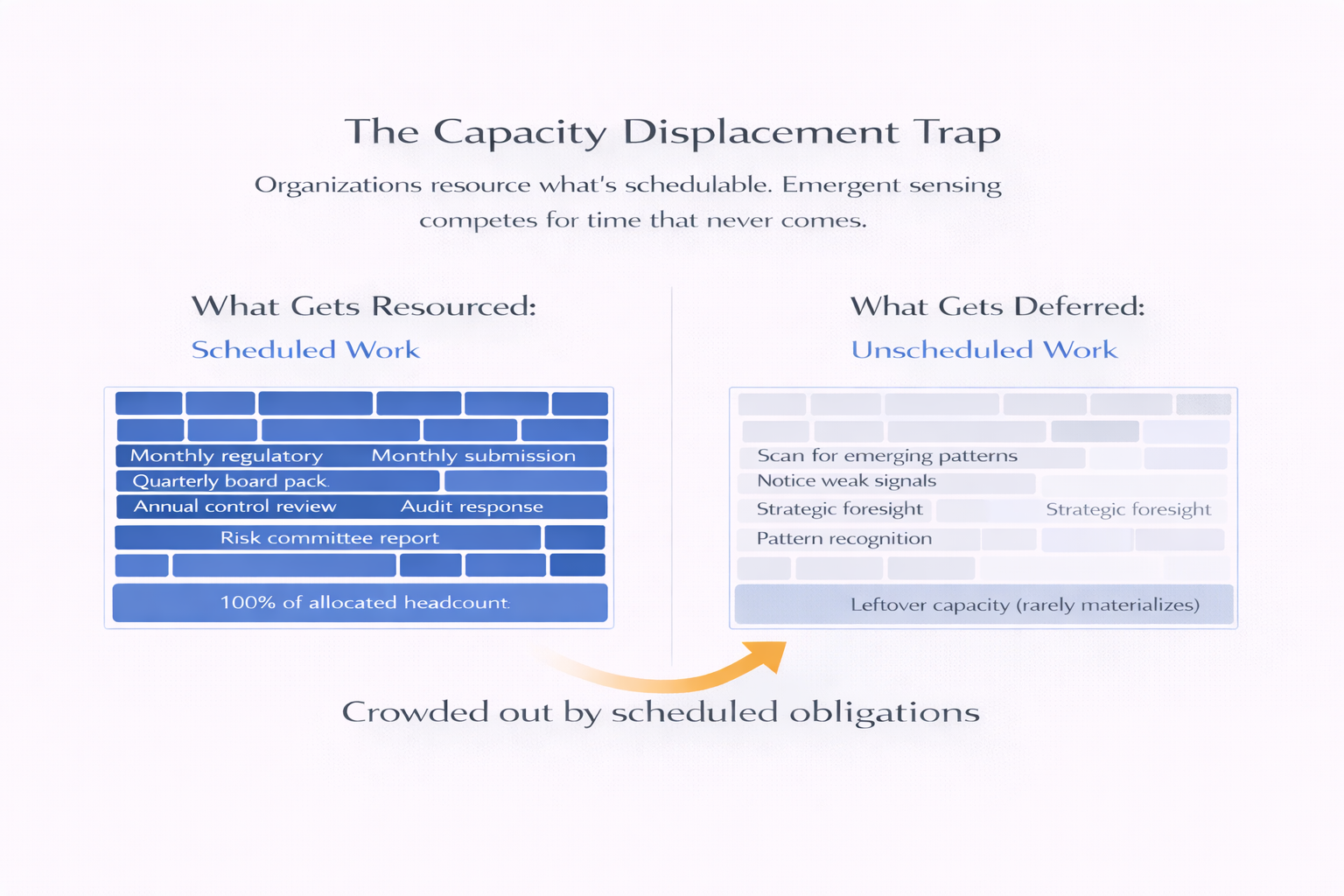
The Capacity Displacement Trap
Organizations resource scheduled work—activities with owners, deadlines, and clear "done-ness." They leave unscheduled work to compete for leftover capacity. Forward-looking sensing is unscheduled, amorphous, and hard to prove. When calendars fill, it gets crowded out—not because it's unvalued, but because it's unschedulable.
The Alibi Effect
The consequence is that “busy” becomes more than an excuse. It becomes evidence of competence.
A risk professional working 60-hour weeks producing comprehensive reports can point to output. The work is visible. Stakeholders see deliverables. Performance reviews can reference completed projects, met deadlines, positive feedback on documentation quality.
A risk professional spending time sensing emerging patterns has nothing to show. No deliverable. No stakeholder feedback. No clear evidence the time was well spent unless a pattern becomes obvious—and if it becomes obvious, the early sensing work becomes invisible.
So risk teams naturally drift toward work that can be defended. Not because they’re avoiding hard thinking, but because organizational performance systems reward visible output and don’t credit invisible judgment.
I’ve watched risk professionals become extraordinarily capable at producing documentation while losing the capacity to sit with ambiguity long enough to notice what’s changing. Not because they forgot how—because the organization made documentation survivable and sensemaking expendable.
A report can be audited. A judgment call can be blamed. When career preservation depends on defensibility, teams optimize for what can be proven after the fact.
“Busy” isn’t an alibi for laziness. It’s evidence of survival inside a system that resources scheduled work and starves emergent sensing.
"Busy isn’t an alibi for laziness. It’s evidence of survival inside a system that resources scheduled work and starves emergent sensing."
The Consequence
The consequence isn’t that risk functions become incompetent. It’s that they become reporting factories.
The team grows. The output becomes more comprehensive. Reporting is on-time, well-documented, audit-ready. Stakeholders receive detailed quarterly updates. The risk register is maintained systematically. Control frameworks are current.
And nobody can explain when the function last identified a strategic risk before it became obvious to everyone else.
The function has optimized for backward-looking production. It documents what happened comprehensively. It tracks what’s already known systematically. It reports on established risk categories thoroughly.
What it doesn’t do—what it no longer has capacity for—is forward-looking pattern recognition. Scanning for what doesn’t fit existing categories. Staying with weak signals long enough to notice what’s changing. Asking if assumptions that looked solid last year are quietly becoming questionable.
Not because the team lacks capability. Because the organization allocated headcount to producing reports and left sensing as something to “fit in when there’s time.”
There’s rarely time.
📌 Key Takeaways:
- 1️⃣ Reporting requirements accumulate through defensible additions. Each one addresses a real need. None retire. The calendar fills while capacity stays flat.
- 2️⃣ Adding headcount creates coordination overhead. Three people hired can create six new coordination steps—the net capacity gain is smaller than expected.
- 3️⃣ Scheduled work crowds out unscheduled work. Organizations resource activities with owners and deadlines. Emergent sensing has neither—so it gets deferred until capacity "opens up."
- 4️⃣ "Busy" becomes evidence of survival. Reports can be audited. Judgment calls can be blamed. Teams drift toward what can be defended after the fact.
The Pattern Isn’t Fixable Through Time Management
The pattern is structural, not fixable through time management training or “just prioritize better.” When organizations resource scheduled work and leave unscheduled work to compete for leftover capacity, they’ve built a system that can only produce yesterday.
Reporting is the work you can prove you did. Sensing is the work you can’t.
Risk teams aren’t choosing documentation over insight. They’re responding rationally to what gets resourced, measured, and defended. The organization allocated headcount to backward-looking production. It left forward-looking sensing as something to “fit in when there’s time.”
There’s never time.
The risk function becomes a reporting factory—not because anyone decided to abandon strategic sensing, but because the capacity architecture made reporting survivable and sensing expendable.
Organizations get the risk oversight they resource. Most just didn’t realize they were resourcing comprehensiveness, not foresight.
Frequently Asked Questions
For readers seeking quick answers to common questions about capacity displacement and the reporting treadmill:
Don’t regulatory and board reporting requirements serve legitimate oversight needs?
Yes—but legitimate requirements can still create capacity displacement. Each reporting addition addresses a real need. The problem isn’t individual requirements—it’s that requirements accumulate and persist while capacity stays flat. Organizations resource what’s schedulable (reporting with deadlines) and leave what’s emergent (sensing) to compete for time that never materializes.
Can’t risk teams simply hire more people to create capacity for both reporting and sensing?
Adding headcount helps initially, but creates coordination overhead. More people means more alignment, version control, sign-off processes, and review cycles. I’ve watched functions hire three people and create six new coordination steps—the net capacity gain is smaller than expected, and new hires get socialized into existing rhythms that prioritize scheduled reporting over unscheduled sensing.
Is this pattern unique to risk functions?
No. It operates wherever organizations resource scheduled work with clear deliverables and leave emergent, unscheduled work to compete for discretionary time. The mechanism—capacity architecture favoring what’s provable over what’s ambiguous—appears across compliance, legal, technical functions, and anywhere career preservation depends on defensible output.
What signals indicate a risk function is experiencing capacity displacement?
Teams working long hours on comprehensive reporting while unable to explain when they last identified an emerging risk early. “Forward-looking analysis” perpetually deferred to “next quarter.” Sensing mentioned in strategy documents but never scheduled, owned, or with clear completion criteria. “Busy” becoming the explanation for why strategic insight work isn’t happening.
Continue the Series
Don't Miss the Next Post
This is Part 4 of a 6-part series examining how risk teams fail through structural design, not incompetence.
Next: How the Three Lines of Defense model creates blind spots where critical risks fall through organizational seams—and why clear division of labor produces unclear ownership.
New posts every week.
Related Reading
- When Independence Becomes Isolation: How the structural separation designed to empower risk teams systematically cuts them off from the early, messy signals they need.
- The Compliance Trap: Why risk teams become reporting factories when asymmetric incentives drive optimization toward compliance over strategic insight.
- Why Expertise Becomes a Liability: How risk teams hired for regulatory credibility struggle with executive influence—because technical precision and strategic positioning require different optimization.
Organizations resource what’s schedulable and starve what’s emergent. Then they wonder why their risk function produces perfect documentation of yesterday.