When Seriousness Arrives Too Late
Part 8 - How organizational urgency arrives without the decision-making capacity to act—and why "Why didn't we act sooner?" is the wrong question about structural failure in risk management.

🌟 RISK JUDGMENT SERIES: When Risk Stops Behaving — Part 8 of 8
This is the final post in the series. We've examined how silence becomes rational, decisions lose custody, governance displaces judgment, escalation erodes, incentives filter truth, experience creates blindness, and judgment gets outsourced. This post reveals the endpoint: when all these mechanisms compound, urgency arrives—but without the capacity, ownership, or clarity needed to act effectively.
The moment arrives.
Not gradually. Not with warning. But suddenly—or so it feels.
A risk that has been visible for months becomes unavoidable overnight. A structural vulnerability that has sat in amber transforms into something requiring immediate explanation. A decision that could have been made with options now must be made under constraint.
And the question everyone asks is the same:
"Why didn't we act on this sooner?"
I've watched this pattern repeat more times than I can count. The urgency is real. The surprise is not.
Because seriousness didn't just arrive. It's been forming quietly through every mechanism we've examined in this series.
It arrived when silence became rational and speaking up felt too costly.
It arrived when decisions lost custody and ownership dissolved across committees.
It arrived when governance displaced judgment and process absorbed anxiety.
It arrived when escalation eroded and responsibility became collective.
It arrived when incentives filtered truth and raising misaligned risks proved politically unviable.
It arrived when experience created blindness and pattern recognition prevented seeing novelty.
It arrived when judgment got outsourced and the capacity to weigh was delegated to systems that couldn't exercise it.
By the time urgency feels unavoidable, it's not that seriousness arrived too late.
It's that the organization spent months conditioning itself not to act—and now lacks the capacity, ownership, and clarity to respond effectively.
This is the endpoint. This is how organizational failure completes itself.
The Moment Urgency Becomes Unavoidable
From inside the organization, urgency feels like it appeared overnight.
Yesterday, the risk was manageable. Under monitoring. Acknowledged but not requiring immediate action.
Today, it cannot be deferred any longer.
I once watched a large exposure that had been deteriorating for nine months suddenly become unavoidable. Not because it defaulted. Not because of an internal breach. But because external accountability arrived.
A routine regulatory inquiry. A seemingly straightforward question that required granular justification: "Walk us through the sustainability of this exposure under stress."
Suddenly, the risk could no longer hide behind optimism, precedent, or political sensitivity.
It had to survive daylight.
Within hours, the response shifted. Not "Is this risk real?" but "How do we explain this?"
Meetings multiplied. CEO, credit, finance, legal, risk—all convened. The tone was tight, defensive, with an undercurrent of urgency that hadn't existed the day before.
The phrases were familiar:
"Let's not overreact."
"This is a timing issue."
"We've managed this relationship for years."
"Can we frame it differently?"
"What's the minimum we need to do?"
The institution wasn't solving the problem. It was managing the conversation.
"This is what 'unavoidable' means in practice: not that action becomes necessary, but that inaction becomes indefensible."
The risk hadn't changed. The visibility had.
Why Urgency Feels Sudden
The illusion is powerful: yesterday it was manageable, today it's crisis.
But this suddenness is constructed through accumulated erosion.
Each delay felt reasonable in isolation. Each deferral had justification. Each decision to wait seemed prudent at the time.
"Let's monitor this."
"We'll revisit next quarter."
"This needs more analysis."
"The framework rates this as medium priority."
"There are broader strategic considerations."
None of these moments felt like failure. Each felt like diligence.
But they compounded.
The risk didn't accelerate. The window for action narrowed.
What could have been addressed through adjustment now requires crisis response. What once had multiple options now has few. What seemed distant became immediate—not because the threat grew, but because the response capacity eroded through each stage we've examined.
The organization rehearsed delay so many times that when urgency finally became undeniable, it had already lost what it needed to respond.
"The organization didn't miss the signal. It trained itself when to ignore it—until ignoring it was no longer possible."
What feels sudden is actually the moment when accumulated erosion becomes visible all at once.
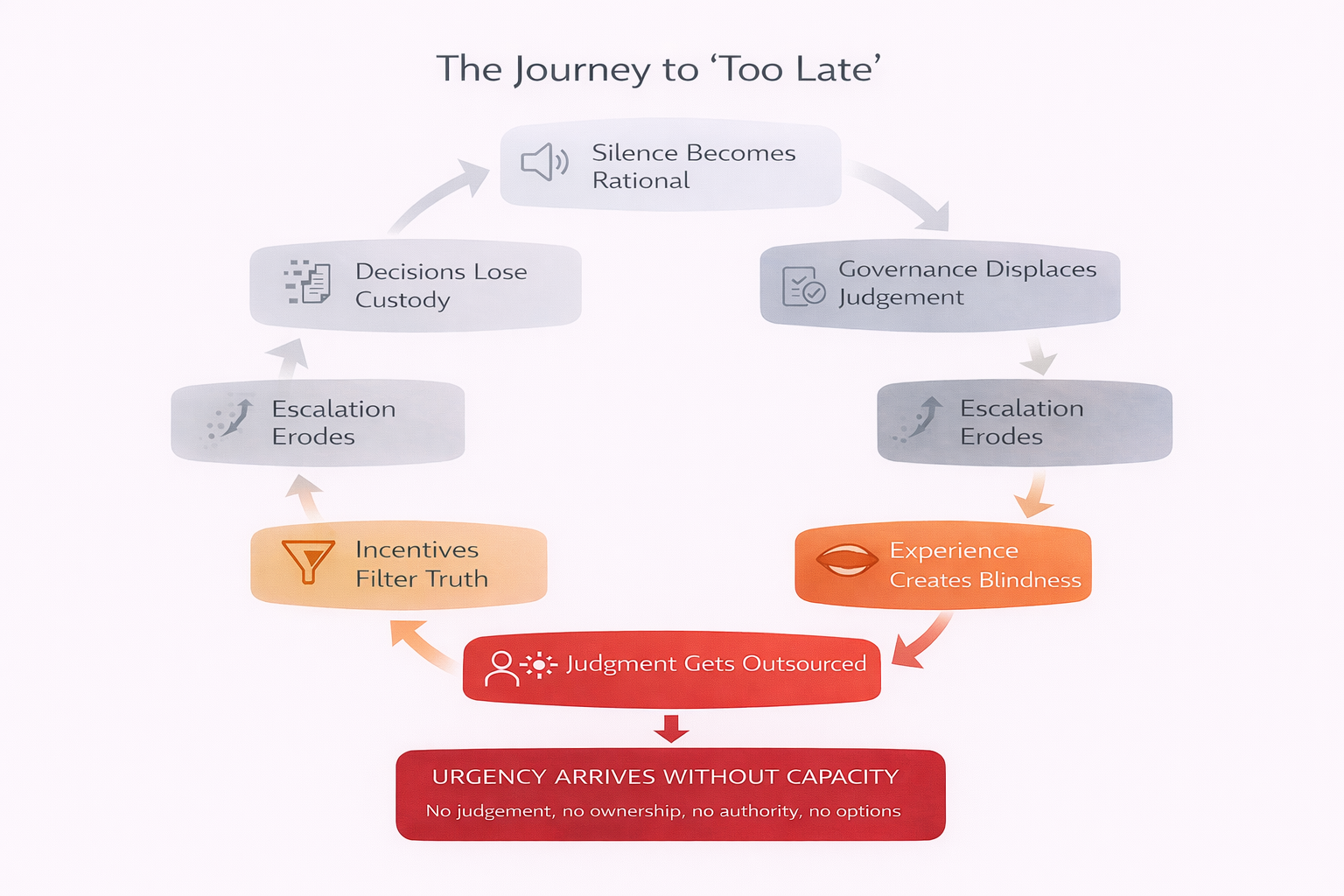
What Arrives Without Capacity
As the cascade shows, when seriousness finally arrives unavoidable, it doesn't arrive alone.
It arrives without judgment—because judgment has been outsourced to tools and frameworks that can't adapt to what they weren't designed for.
It arrives without ownership—because responsibility has been distributed across so many committees and processes that no one is clearly carrying it.
It arrives without authority—because the people who recognize the problem lack the power to act, and the people with power lack the proximity to urgency.
It arrives without clarity—because the organization can't reconstruct how it got here. The erosion was gradual. The rationalization was continuous. Each step felt justified.
And it arrives without options—because the response window narrowed while the organization rehearsed its own inaction.
In the case I watched, when urgency hit, a decision needed to happen within days. Not weeks. Days.
But the structure couldn't deliver it.
Those closest to the risk—the people who understood the deterioration, who had been tracking it for months—could analyze and flag issues but had no decision rights.
Those with decision rights—executive level, board level—were not close enough to the detail to act immediately.
There was no mechanism for early intervention in grey-zone scenarios. The exposure hadn't breached a hard limit. It hadn't defaulted. It was deteriorating but not yet failed.
And the frameworks were designed to monitor and report deterioration, not to authorize action before breach.
Any decision required full committee cycles. Credit forum, then executive, then board. The governance cadence was incompatible with urgency.
Someone said it explicitly: "We don't have what we need to respond effectively."
Not "We don't know what to do." Not "We lack information." "We don't have what we need."
The capacity had been systematically removed—one reasonable governance decision at a time.
What remained was urgency demanding action from an organization that had quietly dismantled its ability to deliver it.
"This is not paralysis from ignorance. It's paralysis from structure."
The organization knew what needed to happen. It simply couldn't mobilize what was required—because those capabilities had been gradually relocated, diluted, and filtered away over months of seemingly reasonable decisions.
The crisis wasn't that the risk materialized. The crisis was that the organization no longer had what it needed to address it.
The Retrospective Illusion
After urgency arrives, the question surfaces reliably:
"Why didn't we act on this sooner?"
It sounds reasonable. Even responsible. It implies accountability. It suggests learning.
But the question itself obscures what actually happened.
Because the organization did see it coming. The signals were raised. Multiple times. Through multiple channels. But each time, the system filtered, redirected, or absorbed them.
In the case I watched, when someone pointed out that the risk had been raised months earlier, the observation was noted, absorbed, then quietly reframed as "hindsight."
The explanations were familiar:
"At the time, there wasn't enough certainty."
"We needed more data."
"The environment was uncertain."
"It would have been difficult to justify."
All technically true. None strategically honest.
Because the real answer wasn't lack of information. It was lack of permission.
Permission to act before breach. Permission to intervene in grey zones. Permission to exercise judgment when frameworks said "monitor" and incentives said "wait."
This is why the retrospective question—"Why didn't we act sooner?"—misses the point.
The organization did try to act. Repeatedly. The system trained it not to.
The Structural Endpoint
The difficulty is that no single mechanism caused this.
It's the accumulation—each compounding the others until urgency arrives and finds nothing left to mobilize.
Each mechanism made sense in isolation. Each addressed a real problem. Each felt like an improvement at the time.
Together, they created an environment where urgency arrives too late—not as an exception, but as a pattern.
This is not a problem that can be solved by adding more process, more tools, more frameworks. Those are often what created the erosion in the first place.
And it's not a problem of bad actors or incompetent leadership. The people involved were capable, thoughtful, acting in good faith.
The problem is structural: organizations that systematically erode their own capacity to respond—one reasonable decision at a time—until urgency arrives and finds nothing left to mobilize.
The cost of delay in the case I watched wasn't disaster. It was loss of optionality.
By the time action happened—and it did, eventually, weeks later—the organization could only respond reactively, not strategically. Management time was diverted to explanation rather than solution. External pressure increased. And the pattern was reinforced: action only happens once urgency is externally imposed.
This is how failure doesn't announce itself loudly.
It accumulates quietly, reasonably, with everyone acting responsibly, until the moment when action becomes unavoidable and the organization discovers it no longer has what it needs.
📌 Key Takeaways:
- 1️⃣ Urgency feels sudden but is actually the endpoint of accumulated erosion—each delay felt reasonable in isolation but compounded over time
- 2️⃣ When seriousness arrives, it arrives without capacity: no judgment (outsourced to tools), no ownership (dispersed across committees), no authority (filtered by process)
- 3️⃣ The organization saw it coming—signals were raised multiple times through multiple channels, but the system trained it not to act
- 4️⃣ No single mechanism caused this—it's the accumulation of all seven compounding until urgency arrives without the means to respond
- 5️⃣ Organizational failure completes itself quietly and reasonably, with everyone acting in good faith, until action becomes unavoidable and the capacity to act has been dismantled
When seriousness arrives too late, the question isn't "Who failed?"
It's "What structure made failure inevitable?"
Because seriousness doesn't arrive too late because no one was watching.
It arrives too late because the organization spent months teaching itself not to act—through every mechanism we've examined.
By the time urgency becomes unavoidable, the question isn't whether the organization will respond.
It's whether the organization still has what it needs to.
And often—too often—it doesn't.
Not because of incompetence.
Not because of negligence.
But because of structure.
This is how organizational failure completes itself: quietly, reasonably, with everyone acting in good faith, until the moment when action becomes unavoidable and the capacity to act has already been dismantled.
The risk was always visible.
The ability to act on it was not.
End of series: When Risk Stops Behaving
This concludes the 8-part series examining how organizational failure emerges from structure, not intent. We've traced the complete arc: from silence becoming rational, through decisions losing custody, governance displacing judgment, escalation eroding, incentives filtering truth, experience creating blindness, and judgment being outsourced—to this final endpoint where urgency arrives without the capacity to act.
Thank you for following this journey. If these insights resonated, consider subscribing to continue exploring how risk, judgment, and organizational dynamics shape what happens when things go wrong.

Subscribe to The Risk Philosopher for thoughtful analysis on emerging risks, risk judgment, and organizational dynamics. New insights weekly.
Related Reading:
In This Series:
- Part 5: How Incentives Quietly Shape What Gets Taken Seriously
- Part 6: When Experience Becomes a Blindfold
- Part 7: How Judgment Gets Quietly Outsourced
When urgency arrives without capacity, the question isn't "Why didn't we act sooner?"—it's "What did we dismantle that would have let us?"