Sensemaking Is the New Risk Leadership
Part 1 - Risk leadership is no longer about prediction—it's about orientation under uncertainty. When frameworks can't keep pace, control becomes a trap. Here's what works: sensemaking, assumption tracking, and making uncertainty discussable.

🌟 RISK JUDGMENT SERIES: The Practice of Uncertainty — Part 1 of 4
This is Part 1 of “The Practice of Uncertainty”—a series on how risk leaders operate effectively when certainty isn’t coming.
Modern risk leadership has shifted from control to orientation. This series explores what that means in practice: where risk decisions actually happen, how to make uncomfortable truths land, and what becomes visible when you stop waiting for clarity.
I’ve watched skilled risk leaders exhaust themselves chasing prediction. Tighter models. Better forecasts. More assurance. And still, they felt like they were missing something.
They weren’t failing. The job had changed.
Risk leadership is no longer about prediction. It’s about orientation under uncertainty.
For a long time, risk leadership came with an unspoken bargain: name the risks, control the outcomes. It was never fully true, but it was stable enough to run on. Registers, controls, models, assurance cycles—a structure leaders could hold.
That structure is breaking down. Not because risk leaders are less competent, but because the texture of reality has shifted. I’ve watched regulatory timelines compress from quarters to weeks while operational cycles stayed the same. The gap creates exposure no framework can capture. Strategic plans that assumed 18-month lead times now face rule changes announced on Friday afternoons. Geopolitical assumptions baked into supply chains unravel faster than governance can respond.
If you’ve felt the ground get less stable, that’s not incompetence. It’s signal.
The job is shifting—not from discipline to improvisation, but from control to orientation.
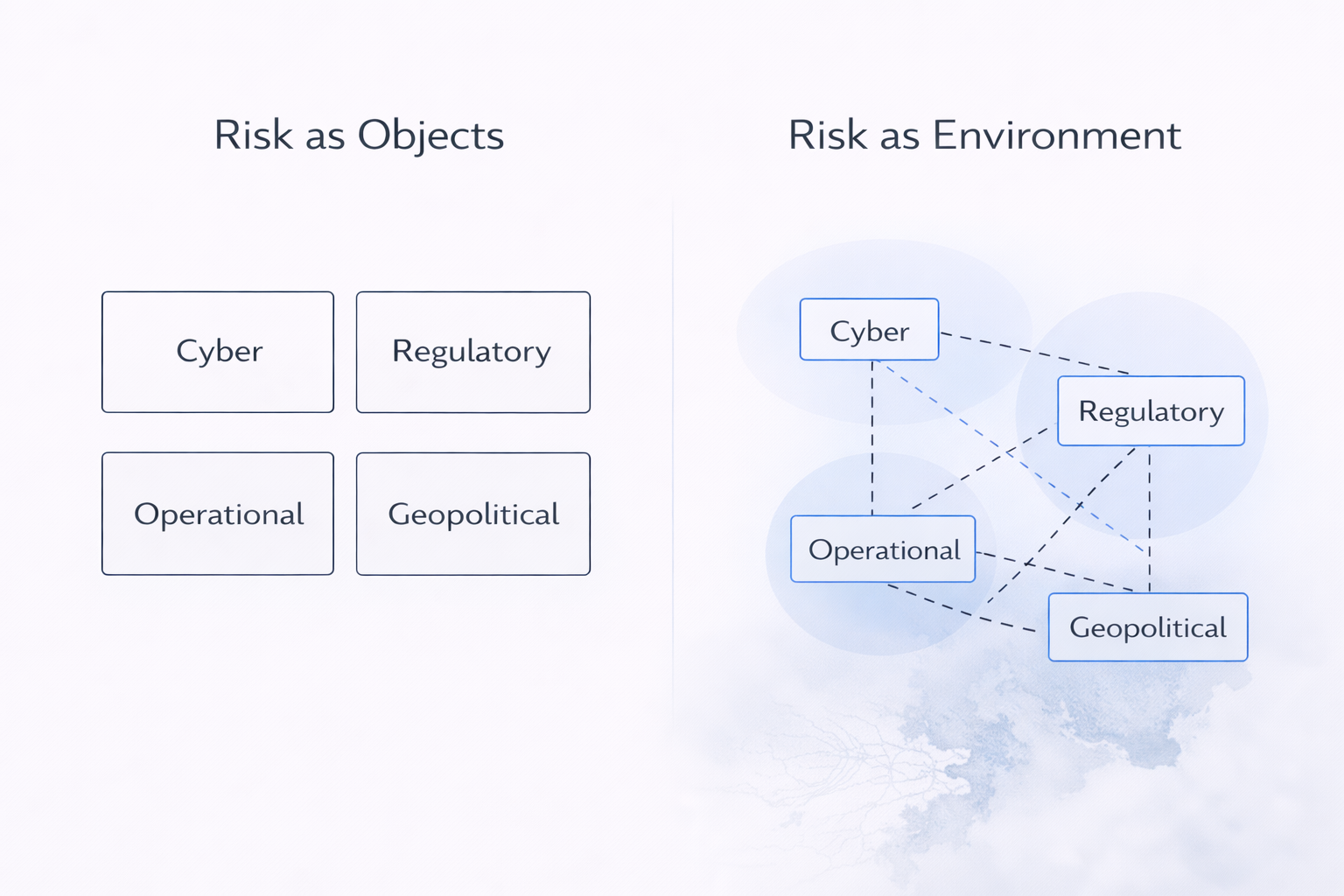
The Real Shift: From “Risk as Objects” To “ Risk as Environment”
Most organizations still treat risk like a set of objects on a table: cyber, regulatory, operational, geopolitical. Neat categories. Assignable owners. Reportable status.
Increasingly, risk behaves less like objects and more like an environment—conditions that shape everything at once.
In an “objects” world, you can box the risk, label it, control it.
In an “environment” world, what hurts you is rarely the headline category. It’s the combination: interactions, timing, dependencies, speed, governance lag, overconfidence disguised as certainty.
So the question becomes less “What are the top risks?” and more “What conditions are changing—and what do those changes make possible?”
That’s sensemaking.
And it’s exactly what control-heavy systems struggle to tolerate.
Why ”Control” Stops Working When Uncertainty Rises
Controls still matter. Governance still matters. But a particular reflex becomes dangerous under uncertainty: the belief that more control will restore safety.
It usually does the opposite.
Control-heavy cultures create three traps.
First, they manufacture certainty you don’t have. Under pressure, precision looks like competence. So we create more metrics, more dashboards, more models that feel complete. The cost is subtle: you stop optimizing for reality and start optimizing for the appearance of certainty. Decisions become confident and structurally brittle.
Second, they punish learning when you need it most. Uncertainty rewards fast cycles—test, adapt, update. But learning implies you didn’t know, so people become reluctant to revise assumptions, change direction, or admit ambiguity. The system waits for clarity. The world doesn’t provide it.
Third, they trap risk leaders in the wrong role. When leaders demand certainty, risk functions try to supply it—becoming corporate forecasters. That’s not the job. The job is helping the organization operate cleanly inside uncertainty.
“Control-heavy cultures don’t fail because they lack discipline. They fail because they optimize for the appearance of certainty instead of learning.”
Sensemaking: What It Is (and What It Isn’t)
Sensemaking isn’t more data. I’ve seen risk committees with 200-slide decks and zero awareness that their key vendor is three weeks from insolvency. Data volume isn’t the same as orientation.
Sensemaking is the discipline of noticing what matters, interpreting what it might mean, naming assumptions, choosing a course of action, learning fast, and repeating without shame.
It’s also deeply social. Organizations don’t fail in uncertainty because facts are hard. They fail because reality becomes politically inconvenient, meaning is contested, incentives warp attention, people can’t say what they see, and everyone wants the comforting story.
Sensemaking makes what’s true discussable—without turning every conversation into a crisis.
Three questions do most of the work:
- What is changing?
- What is interacting?
- What are we assuming without saying out loud?
The New Operating Model for Risk Leaders
A better mental model now is the risk leader as orienteer—not the person claiming perfect knowledge of the terrain, but the person helping the group move through it without pretending the weather is stable.
In practice, that means four consistent practices: assumption inventory, conditions tracking, decision translation, and making uncertainty discussable.
Assumption inventory means asking: What must be true for this plan to work? Which assumptions are drifting? Most strategies carry unstated dependencies—vendor stability, regulatory continuity, market liquidity, management attention. When these shift quietly, exposure compounds before it’s visible.
Conditions tracking means watching shifts in the environment that change your risk profile before incidents arrive. This isn’t horizon scanning for headlines. It’s pattern recognition: which combinations of changes create new exposure? What looked stable last quarter but is moving now?
Decision translation means turning risk into trade-offs, constraints, options, and triggers—not just ratings. Boards don’t need heat maps. They need to understand what they’re buying with speed, what fragility they’re accepting, and what signals would force a change in course.
Making uncertainty discussable means being clear about what we know, what we don’t, and what we’ll do anyway. This is how you keep reality in the room without becoming the “no” person.
“Organizations don’t fail in uncertainty because facts are hard. They fail because reality becomes politically inconvenient.”
A Lightweight Discipline, If You Need One
If you want a starting structure, try this: a weekly sensemaking loop, 30 to 45 minutes.
Signal: one shift worth noticing—not news, not noise.
Meaning: what might it change or interact with?
Assumption: which "stable" belief is drifting
Action: one trigger to monitor or one small reversible move.
Output: a one-page note with three signals, two hypotheses, one action, one question for ExCo or Board.
Sensemaking isn’t a crisis activity. It’s a weekly discipline that keeps you oriented before the fog becomes panic.
What Boards and ExCos Should Ask For Now
Boards don’t need more assurance theatre. They need better orientation.
The questions that help:
- What assumptions are we relying on most heavily?
- Which conditions would force us to adapt?
- What becomes correlated under stress?
- Where are we overconfident?
- What triggers tell us to change course?
- What options have we built—and how fast can we move between them?
These aren’t softer questions. They’re harder ones. They require intellectual honesty instead of performative confidence.
📌 Key Takeaways:
- 1️⃣ The shift: Risk leadership has moved from controlling discrete risks to orienting within an uncertain environment—from “risk as objects” to “risk as environment.”
- 2️⃣ The trap: Control-heavy cultures manufacture false certainty, punish learning when you need it most, and trap risk leaders in the wrong role as corporate forecasters.
- 3️⃣ The practice: Sensemaking means noticing what matters, interpreting what it means, naming assumptions, and making uncertainty discussable without creating crisis.
- 4️⃣ The questions: Three questions do most of the work—What is changing? What is interacting? What are we assuming without saying out loud?
- 5️⃣ The discipline: A weekly sensemaking loop (30-45 minutes) creates orientation before fog becomes panic—signals, meaning, assumptions, action, output.
The environment changed—and when environments change, job descriptions change too.
Risk leadership is no longer the pursuit of control. It’s the craft of orientation: a steady relationship with reality, and a disciplined ability to act without pretending you know more than you do.
Orientation is what control used to give us.
Now we have to build it differently.
Frequently Asked Questions
For readers seeking quick answers about how sensemaking differs from traditional risk management:
Why can’t we just improve our existing risk frameworks instead of adopting sensemaking?
Because most frameworks assume a level of stability that no longer exists. They’re designed to categorize, measure, and control discrete risks—which works when risks behave like objects. When risk behaves like an environment (interconnected, fast-moving, context-dependent), adding more framework often creates rigidity instead of resilience. Sensemaking doesn’t replace frameworks; it helps you understand when the assumptions underneath those frameworks are shifting.
Isn’t this just rebranding what good risk leaders already do?
Partly, yes. The best risk leaders have always operated this way—they just didn’t have language for it. But most organizations still reward the appearance of control over the practice of orientation. Making sensemaking explicit gives leaders permission to operate differently: to name uncertainty instead of hide it, to track conditions instead of just incidents, and to help boards ask better questions. The shift isn’t just individual behavior—it’s organizational legitimacy for a different way of working.
How do I convince leadership that sensemaking is worth the time?
Don’t ask for permission to “do sensemaking.” Just do it—and translate the output into language leadership already values. Frame it as assumption testing, not philosophy. Show how tracking conditions prevents surprises, not how intellectually sophisticated the practice is. Leadership doesn’t need to understand sensemaking; they need to see that you’re oriented when others are lost. Deliver clarity in uncertainty, and the practice sells itself.
Next in the series: The Meeting After the Meeting
Understanding sensemaking is one thing. Knowing where risk decisions actually happen is another. Next week: why the real work doesn’t happen in the scheduled meeting—and what that means for how you show up.

Want frameworks for operating in uncertainty?
Subscribe to The Risk Philosopher get the rest of this series.
Related Reading:
- Read the previous series: “When Risk Stops Behaving”
- Explore Emerging Risks
- About The Risk Philosopher
Orientation is a practice, not a gift. It starts with one question: What am I assuming without saying out loud?