The Temporal Mismatch
Part 2 - Risk accelerates continuously while governance remains periodic. Frameworks look backward while risk moves forward. This temporal mismatch isn't a flaw—it's structural. And it's creating a new kind of organizational drift.

When Risk Moves Faster Than the Systems Designed to Govern It
📊 EMERGING RISKS SERIES: Why The Old Tools Fail Quietly — Part 2 of 4
Traditional risk tools are failing quietly across multiple dimensions. In Part 1, we examined how AI risk escapes technical framing through organizational drift. This post explores a deeper structural problem: the growing gap between how fast risk moves and how slowly our systems respond.
I. The Speed Gap
When Governance Rhythms No Longer Match Risk Velocity
A financial institution’s risk committee meets monthly. In the four weeks between their November and December meetings, their main counterparty’s credit rating was downgraded, a regulatory consultation closed, a geopolitical event shifted sanctions exposure, and three AI models went into production.
The December committee reviews November’s dashboard. Everything looked fine then.
The gap isn’t incompetence. It’s tempo.
There was a time when governance moved at roughly the same pace as risk. Boards met. Policies evolved. Models were recalibrated. When disruption arrived, institutions absorbed it—and returned to rhythm.
That rhythm no longer holds in modern, layered organizations.
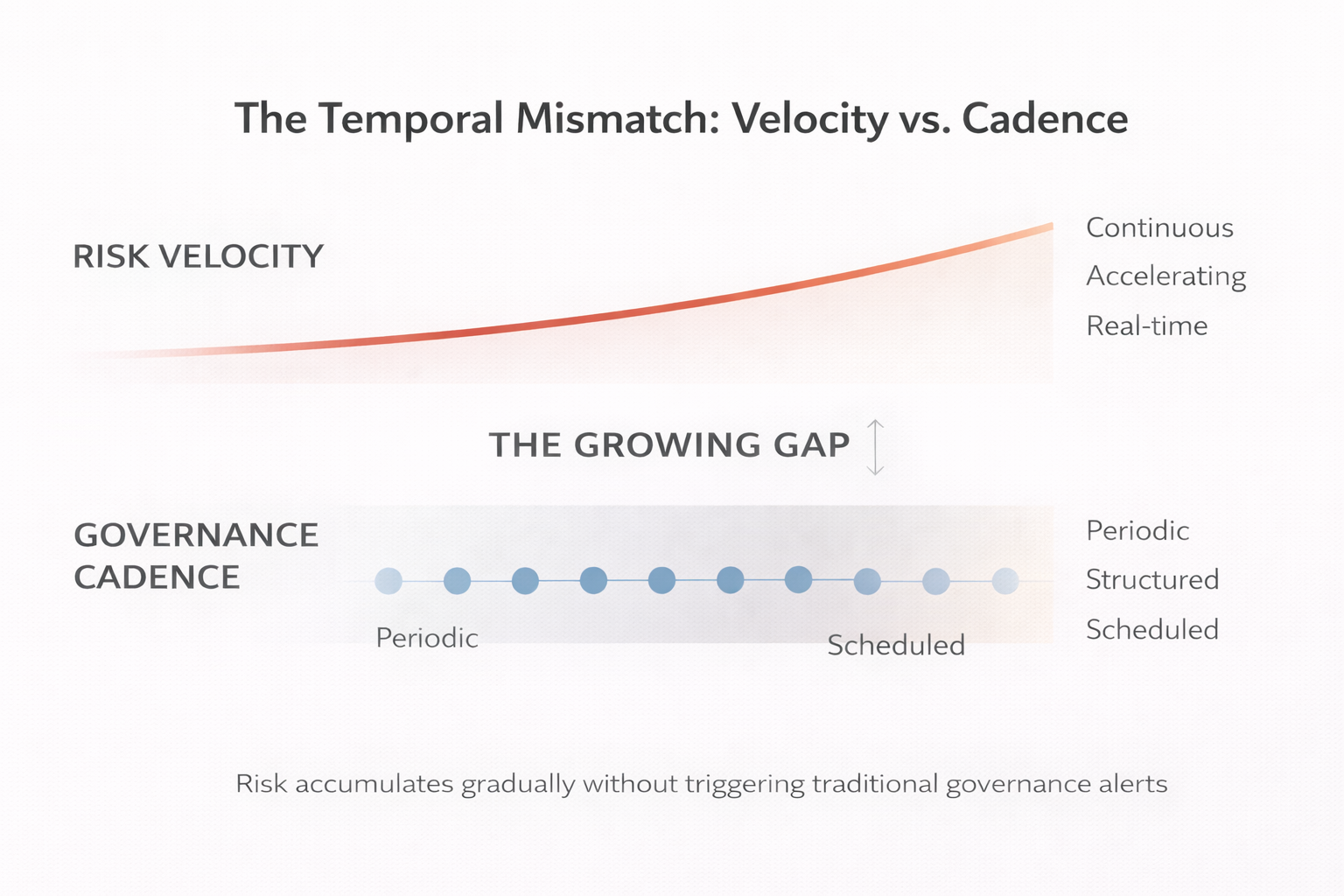
Risk now accelerates continuously. It mutates between meetings. It compounds between reporting cycles. And governance—by design—remains periodic, structured, deliberate. Slow.
Governance, in its broadest sense—the structures, committees, policies, and decision rhythms organizations use to steer risk—is still built for cadence, not velocity. This creates a widening gap. Not a failure of intent, but a failure of tempo.
Most institutions are still governed as if the future arrives one agenda item at a time. In reality, it arrives in overlapping fragments—faster than formal oversight can metabolize. So organizations respond the only way systems do under time pressure: they shorten attention, lean harder on process, and mistake motion for control.
II. When Risk Domains Collide
The Compression Effect
The speed gap would be survivable if risks still arrived sequentially. They don’t.
The old mental model assumed a certain order. First technology changes. Then regulation responds. First geopolitical events occur. Then markets react. First climate events happen. Then balance sheets adjust.
That sequencing is breaking.
Today, risk domains collide inside the same decision window. Technology choices carry immediate geopolitical consequences. Climate volatility becomes a credit and insurance issue simultaneously. A regulatory signal becomes a funding question before the guidance is even finalized. A model change becomes a reputational event while still in testing.
This is compression: not more risk, but less separation between risks. Less time to process each one individually.
Under compression, decision-makers lose the luxury of depth. They rely on what’s immediately available—last quarter’s assumptions, last year’s frameworks, last meeting’s narrative. The organization still appears governed. Committees function. Papers circulate. Dashboards update.
But steering gives way to absorption.
I’ve watched senior teams spend forty-five minutes debating the format of a risk report, then approve three material decisions in the final ten minutes because “we’re out of time.” The governance process ran. The rhythm held. But the actual steering—the hard questions, the uncomfortable trade-offs—got compressed into whatever cognitive space remained.
This isn’t laziness. It’s what happens when the cadence of oversight can no longer match the velocity of change.
III. Why Frameworks Can’t Catch Up
The Backward-Looking Architecture of Risk Management
The speed problem would be manageable if our frameworks could adapt quickly. They can’t—and it’s not because they’re poorly designed. It’s because they’re doing exactly what they were built to do.
Most risk frameworks are excellent at one thing: explaining the past.
Risk taxonomies help name what has already happened. Risk appetite statements help bound what has already been experienced. Controls help demonstrate that reasonable steps were taken—after the fact. All useful. All largely retrospective.
Even “forward-looking” governance often turns out to be historical thinking expressed in future tense. Stress scenarios are calibrated to past crises. Models are validated against historical data. Thresholds are set based on observed volatility.
This is rational. It’s how frameworks earn credibility. But it creates a structural lag.
Frameworks are optimized for explanation, not anticipation.
They’re exceptionally good at telling a coherent story about what happened, why it made sense given the data at the time, and how similar outcomes might behave under slightly altered conditions. That strength becomes a limitation when risk no longer behaves incrementally.
Calibration sits at the intellectual core of most frameworks. Models, thresholds, limits, and stress parameters are anchored in historical loss experience, observed volatility, and past episodes. This is necessary. But calibration optimizes fit to known terrain. Emerging risk materializes off-map.
When novelty appears, frameworks rarely fail loudly. They remain internally consistent while becoming increasingly misaligned with reality. The danger is not error. It is confidence.
Historical data carries authority because it appears objective. Yet datasets encode more than outcomes. They reflect what organizations chose to measure, which risks were considered legitimate, which warnings were delayed or ignored or politically inconvenient.
Risks that almost materialized rarely leave a trace. Suppressed signals disappear entirely. Absence of data is often interpreted as absence of risk—when it may simply reflect absence of precedent.
Frameworks built on clean datasets can therefore appear most robust precisely where uncertainty is highest. This creates an illusion: governance feels complete when it may only be comprehensive within a worldview that’s already outdated.
IV. The Compounding Effect
When Speed and Structure Collide
When the speed gap combines with backward-looking frameworks, something more dangerous emerges than either problem alone.
Governance becomes retrospective theater.
This is the hardest dynamic to name because it doesn’t feel like failure. Committees still meet on schedule. Papers still get reviewed. Decisions still get documented. Status indicators remain green. From a process perspective, everything appears functional.
But underneath, three shifts occur:
First, governance loses steering capacity. Oversight happens, but it’s always slightly behind. By the time a risk surfaces in formal reporting, market conditions have moved. By the time a committee debates a decision, the context has shifted. The governance apparatus still turns—it’s just no longer connected to the steering wheel.
Second, human strain increases without acknowledgment. At senior levels, compression produces familiar patterns: cognitive overload as domains multiply faster than expertise can keep up, simplification under pressure as complexity gets reduced to a single storyline, and process substitution as procedures replace judgment.
I’ve sat in rooms where highly capable people were managing their own bandwidth more than they were managing the risk itself. Not because they didn’t care—because the system was asking them to sequence what could no longer be sequenced.
Third, organizations drift without realizing. Decisions start to make sense locally but not systemically. Governance that still functions no longer quite connects to the world it’s meant to oversee. Nothing breaks. Nothing triggers an alarm. Things simply begin to drift.
It’s possible to stay profitable this way. To stay compliant. To stay operationally occupied. And only later realize that governance didn’t fail in a dramatic way—it just fell slightly behind, and never quite caught up.
"Governance didn't fail dramatically. It just fell slightly behind, and never quite caught up. That lag is easy to miss while you're inside it—it feels like normal pressure, normal complexity, normal leadership. Until, with hindsight, it becomes obvious the system wasn't overwhelmed. It was outpaced by risk it could no longer sequence."
V. The New Failure Mode
When Drift Replaces Crisis
Failure is still imagined as something sudden. A shock. A breach. A moment that forces attention.
But increasingly, that’s not how things unravel.
What shows up first is a subtle loss of alignment. Decisions that make sense locally but not systemically. Governance that still functions, but no longer quite connects to the world it is meant to oversee. Nothing breaks. Nothing triggers an alarm. Things simply begin to drift.
Organizations don’t lose control of risk overnight. They drift. Judgment becomes procedural. Challenge becomes performative. Accountability becomes ambient rather than owned.
Nothing “goes wrong” in the conventional sense. Decisions continue to be made. Performance indicators remain stable. Governance processes remain intact. But situational awareness erodes.
Over time, organizations become less able to explain why decisions are made—only how they were arrived at. The distinction matters. When outcomes eventually disappoint, post-hoc explanations focus on process rather than judgment. Learning becomes shallow.
The system wasn’t overwhelmed. It was outpaced by risk it could no longer sequence.
This is what temporal mismatch actually looks like in practice. Not catastrophic failure. Not obvious breakdown. Just a gradual loss of alignment between the speed at which risk moves and the rhythm at which governance responds—until the gap becomes too wide to ignore.
VI. What This Changes for Risk Leaders
Living With Structural Lag
There’s a temptation to end here with solutions. Five steps to close the gap. A new framework for real-time governance. Technology that accelerates oversight.
That instinct misses the point.
The temporal mismatch isn’t a problem to be solved. It’s a condition to be navigated. Risk will continue to move faster than governance structures can adapt. Frameworks will continue to look backward even as risk moves forward. This gap is structural.
What changes is how risk leaders think about their role.
Recognize the mismatch for what it is:
- Risk operates on velocity—continuous, accelerating, simultaneous. Governance operates on cadence—periodic, structured, sequential. Frameworks operate on history—calibrated, validated, retrospective. These aren’t aligned. They can’t be aligned. The question isn’t how to fix the gap—it’s how much gap your organization can tolerate.
Shift the focus:
- From prediction to adaptive capacity. Can your organization adjust quickly when conditions change, or does it need certainty before moving?
- From control to awareness. Are you trying to control risk through process, or building the organizational awareness to notice when risk is shifting?
- From documentation to judgment. Is governance producing artifacts that satisfy compliance, or preserving space for genuine judgment under pressure?
- From thresholds to gradients. Are you waiting for a metric to breach, or watching for subtle shifts in behavior, language, and decision quality?
Watch for specific signals:
When governance rhythms feel comfortable but steering feels absent. When frameworks provide reassurance but not relevance. When retrospective explanations satisfy process requirements but not understanding. When “everything is fine” in the dashboard but unease is rising in private conversations.
These don’t trigger traditional risk alerts. That’s the problem.
The uncomfortable question every CRO should ask:
Is your organization governed for the world as it was, or as it is becoming?
Most governance structures were designed when risk moved more slowly, arrived more sequentially, and behaved more predictably. That world is gone. But the structures remain—and the lag between the two is where risk quietly accumulates.
This isn’t about abandoning frameworks or dismantling governance. It’s about recognizing their limits, understanding what they can and cannot see, and building the judgment to act in the spaces where process can’t reach.
📌 Key Takeaways:
1️⃣ Risk now operates on velocity (continuous, real-time) while governance operates on cadence (periodic, structured)
2️⃣ Risk frameworks are optimized for explanation, not anticipation—they look backward while risk moves forward
3️⃣ This creates compression: multiple risk domains colliding inside the same decision window
4️⃣ Organizations don't fail dramatically—they drift as governance lags behind risk velocity
5️⃣ The gap is structural, not fixable through "better frameworks"—it requires different questions and adaptive capacity
Closing Note
The temporal mismatch isn’t new. Organizations have always struggled to keep pace with change. What’s different now is the degree and the consequences.
When risk moved more slowly, governance could catch up during the next cycle. Frameworks could recalibrate after the fact. Leaders had time to notice drift and correct course.
That margin has disappeared.
Risk now compounds faster than oversight cycles. Frameworks recalibrate too slowly to matter. By the time drift becomes obvious, months of misalignment have already accumulated.
The question for risk leaders isn’t how to eliminate the lag—it’s how to govern effectively while acknowledging it exists.
Frequently Asked Questions
For readers seeking quick answers to specific questions about the temporal mismatch in risk management:
Why can't governance keep pace with risk anymore?
Governance was designed for cadence—periodic meetings, structured reviews, scheduled updates. Risk now operates on velocity—continuous change, simultaneous events, compressed timelines. The mismatch is structural: one system moves in rhythms, the other in real-time. As risk accelerates and domains increasingly collide, the gap between governance tempo and risk velocity widens beyond what traditional structures can bridge.
What is the temporal mismatch in risk management?
The temporal mismatch describes three fundamental disconnects in how organizations manage risk. First, risk moves continuously while governance moves periodically. Second, frameworks look backward (calibrated on history) while risk moves forward. Third, organizations need real-time awareness but operate on lagged data and delayed reporting cycles. Together, these create organizational drift without anyone noticing until the gap becomes significant.
Why do risk frameworks focus on the past instead of the future?
Risk frameworks are optimized for explanation, not anticipation. They're calibrated on historical data, validated against past events, and designed to explain what happened rather than predict what's coming. This backward-looking design isn't a flaw—it's what makes frameworks credible and defensible. They earn trust by accurately explaining the past. But this same strength makes them poor instruments for anticipating genuinely new risks that don't yet have historical precedent.
How does compression affect risk decision-making?
Compression occurs when multiple risk domains collide inside the same decision window. Technology, regulation, geopolitics, and market shifts that once arrived sequentially now arrive simultaneously. Decision-makers lose the luxury of addressing each domain with depth and instead default to what's immediately available—last quarter's assumptions, last year's frameworks, last meeting's narrative. Governance processes continue to function, but actual steering gets compressed into whatever cognitive space remains after procedural requirements are met.
What happens when governance lags behind risk?
When governance lags, organizations don't fail dramatically—they drift. Committees still meet, papers still circulate, dashboards still update. But oversight happens slightly behind reality. By the time a risk surfaces in formal reporting, conditions have moved. By the time a committee debates a decision, context has shifted. Decisions make sense locally but not systemically. The governance apparatus still turns—it's just no longer connected to the steering wheel. By the time the lag becomes obvious, months of misalignment have accumulated.
What should risk leaders do about the temporal mismatch?
Recognize that this gap is structural, not fixable through "better frameworks" or faster meetings. The work shifts from trying to eliminate the lag to governing effectively while acknowledging it exists. This means building adaptive capacity over prediction capability, prioritizing awareness over control, preserving judgment over documentation, and watching gradients rather than waiting for thresholds to breach. The question isn't how to make governance match risk velocity—it's how much lag your organization can tolerate and still steer effectively.
Next in this series: Part 3: Where Risk Becomes Invisible—how organizational blind spots multiply risk faster than frameworks can detect.
Subscribe to The Risk Philosopher to follow this 4-part series examining how traditional risk frameworks fail to keep pace with reality—and receive new posts on risk judgment and emerging risks.
Related Reading:
In This Series:
- Part 1: AI Risk Is Not a Technology Problem
- Part 3: Where Risk Becomes Invisible—Organizational Blind Spots (Coming soon)
- Part 4: After The Old Tools—What Comes Next (Coming soon)
The gap between risk and response isn’t a problem to solve. It’s a condition to navigate.