Risk Escalation Fails Long Before Anyone Raises Their Voice
Part 4 - How organizational risk escalation erodes through gradual wear in governance layers rather than sudden blockage—and why this feels abrupt when it becomes unavoidable to leadership.

🌟 RISK JUDGMENT SERIES: When Risk Stops Behaving — Part 4 of 8
We've traced how silence becomes rational, how decisions lose custody, and how governance displaces judgment. This post examines what these structural failures produce: escalation that erodes through gradual wear rather than sudden blockage.
The posts that follow explore how incentives filter truth, how experience blinds us, and how judgment gets outsourced—showing why urgency arrives too late even when everyone was watching.
I've watched risks escalate too late—not because no one saw them, but because they'd already passed through five layers of review, each one making them slightly less urgent, slightly less owned, slightly easier to defer.
By the time someone finally raises their voice, the risk has often been visible for months.
Risk escalation rarely fails at the moment someone stays silent.
It fails much earlier—after issues have been acknowledged, discussed, and formally noted.
This is how organizational risk escalation fails—not through silence, but through gradual erosion.
By the time escalation is demanded, the risk has often already passed through multiple layers of review, each one making it slightly less urgent, slightly less owned, and slightly easier to defer. What eventually looks like a failure to escalate is usually the final stage of a quieter process—one that trains the organisation to experience delay as prudence.
Escalation is rarely blocked.
More often, it is slowly worn down.
This happens after silence has become rational, decisions have lost custody, and governance has displaced judgment—escalation is the culmination of these structural failures.
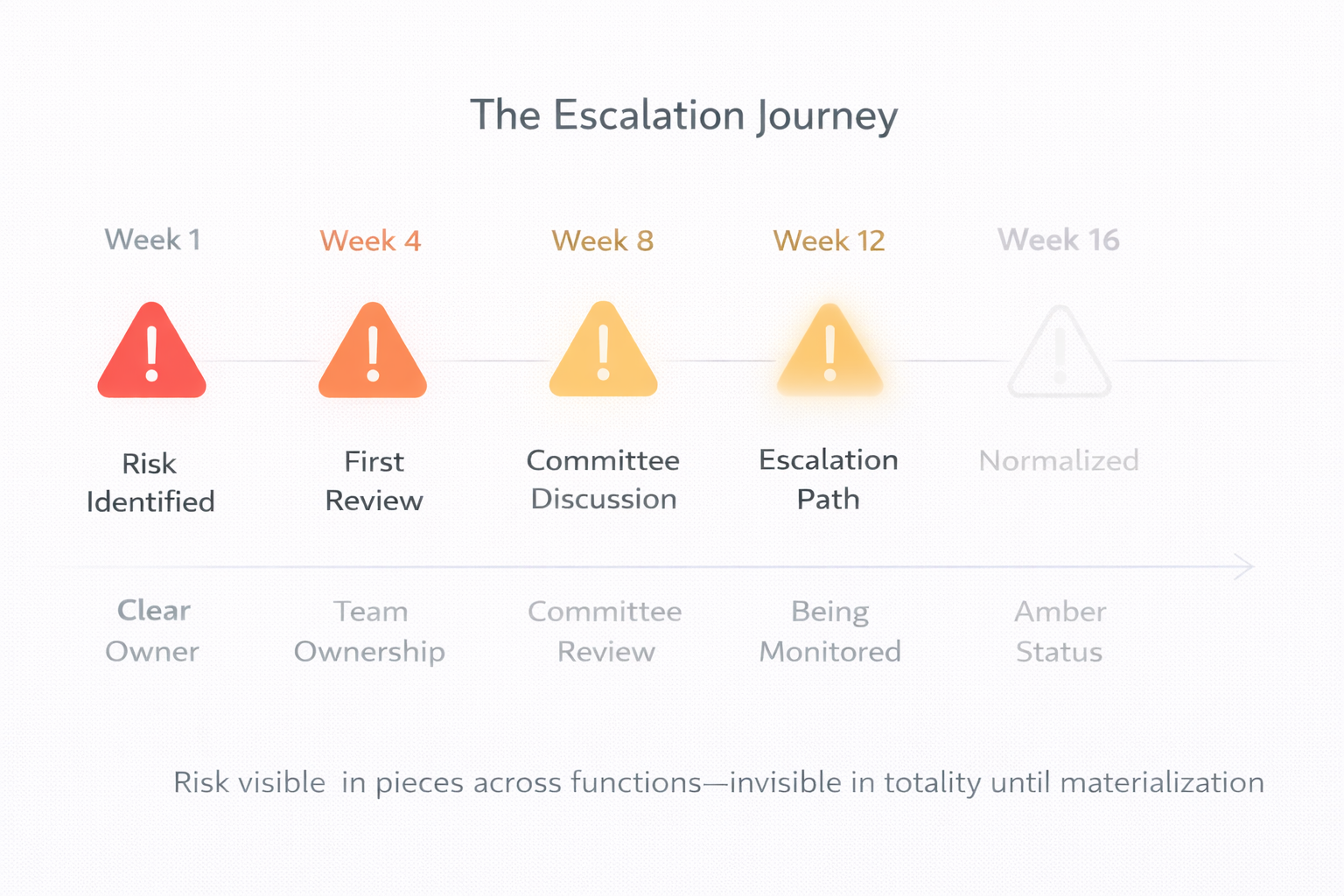
Escalation Is Not An Act—It's a Journey
Most organisations behave as if escalation is a switch: something that either happens or doesn't. Someone raises their hand. Someone else listens. Action follows.
That model is comforting—and wrong.
In reality, escalation is a journey a signal takes through layers of language, process, and authority. At each step, the issue doesn't disappear. It changes form. It becomes more qualified. More contextualised. More carefully framed.
This is the organizational echo of how decisions lose custody—both suffer from the same structural flaw: responsibility diffuses as issues move upward.
By the time it reaches senior forums, the original signal is often still present—but thinner. Less sharp. Easier to hold without acting.
"Visibility remains. Momentum does not."
How Ownership Quietly Dissolves
Early on, risks often have names attached to them.
Someone is responsible. Someone is expected to act.
As the issue moves upward, ownership tends to blur.
Stage 1: "X needs to address this" (named person)
Stage 2: "Management is looking into it" (team)
Stage 3: "This is being monitored" (process)
Stage 4: "We have visibility on this" (passive)
Accountability shifts from a person to a process. From a role to a forum. From action to oversight.
When responsibility becomes collective, follow-through quietly becomes optional.
Nothing explicitly resists ownership. It simply spreads.
Decisions are taken, but no one is clearly carrying them forward. Follow-up becomes shared—and therefore diluted. What remains is motion: papers, updates, tracking points. The appearance of progress without the burden of consequence.
Over time, this isn't always driven by bad intent. Often it reflects something quieter: an inability to hold judgment beyond the meeting itself.
How Urgency Is Trained Out of The System
Time plays a subtler role.
Most escalation failures are not marked by urgency being dismissed—but by it being rescheduled.
"Let's monitor."
"Let's see how this evolves."
"We'll revisit this next quarter."
Each delay feels reasonable in isolation. Taken together, they condition the organisation to experience persistence as stability.
This is how governance becomes a substitute for judgment—the system optimizes for safety over decision, for process over action.
Amber risks linger for months. Sometimes years. Not because they are invisible, but because familiarity dulls their edge. The organisation learns to live with them—until it can't.
By then, the question is no longer what happened, but why this feels sudden.
The Illusion of The Escalation Moment
Only in hindsight does this slow erosion get mistaken for a single missed moment.
After the fact, the same questions reliably surface:
Why didn't this get escalated sooner?
I was not aware of this.
They sound reasonable. Even responsible. That's what makes them dangerous.
They rest on a flawed assumption: that escalation is a discrete moment, rather than a gradual erosion.
They assume awareness appears suddenly, fully formed—rather than being slowly reshaped by process, language, and delay. They imply that escalation failed because someone didn't act, rather than because the system repeatedly taught the issue that now was never quite the time.
By the time escalation is demanded, the organisation has often already rehearsed its own unawareness.
📌 Key Takeaways:
- 1️⃣ Escalation is a journey through organizational layers—signal remains visible but momentum disappears
- 2️⃣ Ownership dissolves from named individuals to teams to process—follow-through becomes optional
- 3️⃣ Urgency isn't dismissed—it's rescheduled, training organizations to experience persistence as stability
- 4️⃣ What looks like sudden failure is actually the endpoint of gradual erosion—the system rehearsed unawareness
- 5️⃣ Real failure is loss of carried responsibility—ownership diluted, urgency rescheduled, judgment deferred
What Actually Failed
What looks, in hindsight, like a failure of escalation is more accurately a failure of carried responsibility.
Ownership was diluted into process.
Urgency was rescheduled into caution.
Judgment was deferred—again and again—until it no longer felt available.
This is not always about fear. And rarely about a single bad decision. More often, it reflects systems that allow responsibility to soften as issues move upward, and people who mistake procedural movement for progress.
When escalation finally becomes unavoidable, it feels abrupt.
In reality, it has been forming quietly for months.
When escalation becomes unavoidable, it feels abrupt—but in reality, it has been forming quietly for months.
Frequently Asked Questions
For readers seeking quick answers about why risk escalation fails before anyone raises their voice:
Why does risk escalation fail even when risks are visible and documented?
Escalation fails not at the moment someone stays silent, but through gradual erosion as issues pass through organizational layers. Each review makes the risk slightly less urgent, slightly less owned, slightly easier to defer. The signal remains visible—it appears in slides, circulates in committees, gets formally noted—but momentum disappears. What eventually looks like a failure to escalate is actually the final stage of a quieter process that trained the organization to experience delay as prudence.
How does ownership dissolve during the escalation process?
Early on, risks have names attached—someone is responsible, someone is expected to act. As issues move upward, ownership blurs: "X needs to address this" becomes "Management is looking into it" becomes "This is being monitored." Accountability shifts from a person to a process, from a role to a forum, from action to oversight. When responsibility becomes collective, follow-through quietly becomes optional. Nothing explicitly resists ownership—it simply spreads until no one is clearly carrying it forward.
Why do escalation failures feel sudden when they've been forming for months?
Organizations mistake gradual erosion for a single missed moment. After the fact, questions surface: "Why didn't this get escalated sooner?" "I was not aware of this." These assume escalation is a discrete moment rather than a gradual erosion, and that awareness appears suddenly rather than being slowly reshaped by process, language, and delay. By the time escalation becomes unavoidable, the organization has already rehearsed its own unawareness. What looks sudden was actually forming quietly for months.
Next in the series: How Incentives Quietly Shape What Gets Taken Seriously
We've traced the structural foundations of failure: silence, decision fade, governance displacement, and escalation erosion. Now we examine the mechanism beneath them all—how incentives filter what becomes urgent, not through active suppression but through quiet alignment with what the system rewards.
Subscribe to The Risk Philosopher to follow this 8-part series examining how organizational failure emerges from structure, not intent—and receive new posts on risk judgment and emerging risks.
Related Reading:
In This Series:
- Part 2: Good Decisions Don‘t Survive Organisations
- Part 3: When Governance Becomes a Substitute for Judgment
- Part 5: How Incentives Quietly Shape What Gets Taken Seriously (Coming soon)
Escalation doesn't fail when no one speaks—it fails when the system trains everyone when not to.