The Meeting After the Meeting
Part 2 - The official meeting is where people show their faces. The real meeting is where they show their worries. Organizations decide through people, and people process threat through social cost before analytical truth.

🌟 RISK JUDGMENT SERIES: The Practice of Uncertainty — Part 2 of 4
This is Part 2 of “The Practice of Uncertainty”—a series on how risk leaders operate effectively when certainty isn’t coming.
Sensemaking shows you what matters. But knowing where decisions actually happen is different. This post examines why the real meeting doesn’t happen in the scheduled hour—and what that means for how risk leaders show up
The official meeting is where people show their faces. The real meeting is where they show their worries.
I’ve watched this pattern hundreds of times: a risk gets raised cleanly in the scheduled hour, acknowledged with the right level of seriousness, discussed just enough to feel legitimate—and then quietly relocated.
Not because anyone is lying. Not because the room is full of villains. But because organizations decide through people, and people process threat through social cost before analytical truth.
This is how risk actually moves inside organizations—not through decisions, but through people.
The Official Meeting: Where Risks Get Acknowledged
The agenda is neat. The tone is polite. Everyone has the right level of seriousness—not too casual, not too alarmed. That corporate sweet spot where you can say “risk” without anyone hearing “problem.”
The risk gets raised carefully. Not performatively. Just cleanly. The kind of delivery that says: I’m not trying to win anything. I’m trying to keep us honest.
And it lands exactly how inconvenient risks often land: with nods that mean “I hear you,” and questions that mean “please don’t make this hard for me.”
Someone asks for more data. Someone suggests a smaller scope. Someone offers a sentence tweak—not because it improves accuracy, but because it makes the idea less sharp.
And then, as predictably as gravity, it arrives:
“Let’s take that offline.”
That phrase is never neutral. It’s a relocation.
Not rejection—worse. A risk can survive rejection. At least it stays intact. But when it gets taken offline, it starts dissolving. It becomes “a concern,” then “a consideration,” then “something we’re monitoring,” and eventually a quiet footnote nobody owns.
The meeting ends the way these meetings often end: with enough apparent alignment to move on, and not enough commitment to move forward.
And then the real day begins.
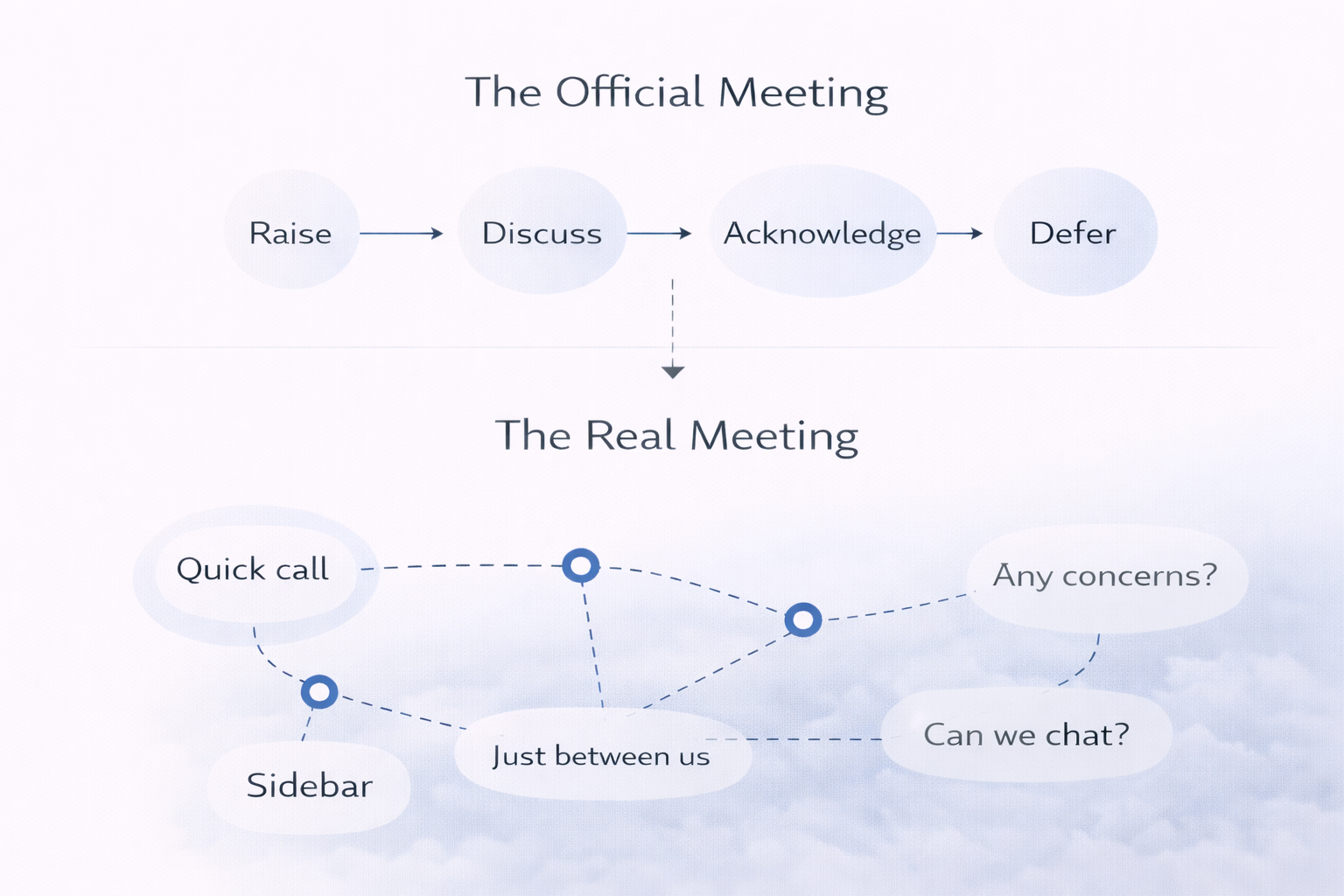
The Meeting After The Meeting: Where Decisions Actually Form
It starts small—the way it always does. A message that looks friendly on the surface.
Another one comes in later, from someone who tends to speak in careful half-sentences.
And then the one that’s honest without meaning to be:
“Good point. Quick one—are you comfortable with the wording?”
That question isn’t about coordination. It’s about risk of a different kind: political cost. The cost of being seen as the person who slows momentum, creates friction, introduces doubt, threatens somebody’s story.
This is the part many risk leaders find hardest to accept. Not because it’s unfair—because it’s so human. People don’t resist risk because they love danger. They resist it because they can feel what it will do to them socially.
A risk doesn’t just threaten outcomes. It threatens identity.
It threatens: “Did we miss this?”
It threatens: “If this goes wrong, who gets blamed?”
And blame is always closer in people’s minds than probability.
So the meeting after the meeting forms—the unofficial sequence of short conversations that actually decide what the official meeting will pretend was decided later.
A quick call. A “can we chat for five.” A sidebar after another meeting. A message sent “just between us.”
And what’s striking is how rarely people argue with the substance of the risk.
They argue with the implications.
They argue with what accepting it would force them to do. What it would slow down. Who it would embarrass. What it would cost. What it would admit.
At some point, the realization lands:
The organization isn’t choosing whether the risk is real.
It’s choosing whether it can afford to acknowledge it.
"Organizations don’t resist risks because they’re false. They resist them because them is socially expensive."
What Works: Three Moves That Create Space For Uncomfortable Truths
The risk leaders who gain traction don’t fight the informal system. They work with it—not cynically, but realistically.
Three moves create space for uncomfortable truths:
Stop selling certainty. Name conditions instead. “If this holds, we’re fine. If it moves, we’re not. Let’s agree what we’d watch.”
That single shift changes the temperature. It lets people engage without feeling trapped into a confession. Watching feels safe. Being forced to admit you’re wrong in public does not.
Make the next step smaller—but sharper. Not “big fix now.” Not “red alert.” Just a move with integrity:
“Give me a week to validate one thing. If it’s real, we bring options. If it’s not, we stop wasting time.”
People don’t fear action. They fear irreversible action that exposes them. So structure the next step to be reversible—without becoming vague.
Remove surprise from the social cost. If the risk threatens someone’s narrative, brief them privately first. Not to dilute the reality—to stop the discussion turning into self-defense.
Surprises create resistance. Familiarity creates space.
This isn’t manipulation. It’s respect for how humans process threat.
The Boundary
There’s a boundary: adjust timing, language, and route—but never the core reality. The moment you soften truth to ease social cost, you’ve lost both the risk and yourself.
"The best risk leaders don’t fight the informal system. They understand where decisions actually form—and show up there with integrity intact."
How It Actually Works
By the end of the week, the decision moves. Not dramatically. Not with fanfare. It moves the way most real decisions move: quietly, after enough people have tested the social cost of being aligned with it—and realized the cost of ignoring it might be worse.
That’s the dynamic worth understanding.
The official meeting will keep saying sixty minutes.
But if you want traction, you have to learn to operate in the time the organization actually uses.
Traction doesn’t live in the agenda.
It lives where people actually decide.
📌 Key Takeaways:
- 1️⃣ The pattern: Official meetings are where people show their faces. Real meetings are where they show their worries—and where decisions actually form.
- 2️⃣ The resistance: Organizations don’t resist risks because they’re false. They resist them because acknowledging them creates social cost—threatens identity, momentum, and narratives.
- 3️⃣ The phrase: “Let’s take that offline” isn’t neutral—it’s a relocation that often dissolves risk from concern to footnote.
- 4️⃣ The moves: Three practices create space for uncomfortable truths—name conditions instead of certainty, make next steps reversible but sharp, remove surprise from social cost.
- 5️⃣ The boundary: Adjust timing, language, and route—but never the core reality. That’s where influence becomes corrosion.
Risk leadership isn’t courtroom logic. It’s sequence design.
The question isn’t “Am I right?” The question is: “What choice will this room realistically make in the next 30 to 60 days—and how do I help them make it with eyes open?”
Traction lives where people actually decide.
Frequently Asked Questions
For readers seeking clarity on how to navigate organizational politics without compromising integrity:
Isn’t this just political maneuvering? How is this different from office politics?
The difference is intent and boundaries. Office politics trades truth for favor. What’s described here is navigating human reality while protecting truth. You adjust when and how a message travels, not what it says. The core reality stays intact. The moment you dilute truth to reduce social friction, you’ve crossed from navigation to corruption. That line is clear—and non-negotiable.
What if the “meeting after the meeting” becomes a way to exclude people or concentrate power?
That’s a real risk, which is why transparency about process matters. The informal system exists whether you acknowledge it or not—pretending decisions happen only in official meetings doesn’t eliminate backchannels, it just makes them less visible. The practice described here isn’t about creating shadow governance; it’s about understanding where human decision-making actually occurs and showing up there with the same integrity you’d bring to the formal room. If the informal system is excluding critical voices, that’s a governance problem to surface—not a reason to ignore how decisions actually form.
How do I know when to escalate formally versus work through informal channels?
Escalate when the exposure is time-sensitive, when silence would imply consent, or when the cost of delay exceeds the political cost of friction. Use informal channels when the system is saturated, when the message is being heard as accusation rather than information, or when what’s needed is better sequencing rather than more volume. The judgment call isn’t about courage versus caution—it’s about reading whether pushing harder will clarify or simply entrench positions. Sometimes protecting long-term credibility matters more than winning a single moment.
Next in the series: From Truth to Traction: How to Land an Inconvenient Risk
Understanding where decisions happen is essential. Knowing how to make uncomfortable risks actually stick is harder. Next: the translations that make risk messages land without diluting them, and the difference between persuasion and sequence design.
Want frameworks for navigating organizational reality? Subscribe to The Risk Philosopher to get the rest of this series.
Related Reading:
The official meeting will keep saying sixty minutes. But traction lives where people actually decide.