Geopolitics Is No Longer a Scenario
Part 2 - Geopolitical risk has shifted from episodic scenario to structural operating condition. Sanctions cascade beyond compliance, capital flows become policy-dependent, trade routes grow conditional—while most risk frameworks still assume convergence and stability that no longer exists.

📊 EMERGING RISKS SERIES: What I'm Watching Now — Part 2 of 5
This post is part of a series on current risk patterns that concern an experienced CRO.
In this post: why geopolitical fragmentation has shifted from episodic disruption to structural condition—and what that means for the assumptions built into risk frameworks.
For the past two years, I’ve been watching geopolitical risk change form—from something you model as a scenario to something you operate inside as a condition.
This isn’t about intensity. Geopolitical tensions have been high before. What’s different is persistence. What used to be episodic disruption has become structural fragmentation—and most risk frameworks are still calibrated for the world that came before.
Scenarios are for things that might happen.
Fragmentation is for things already underway.
What has changed is not the intensity of geopolitical risk, but its form. It has shifted from episodic disruption to structural condition—from an input into risk models to the environment in which those models now operate.
We are no longer managing geopolitical events.
We are operating inside geopolitical constraints.
From Shocks to Conditions
Most risk frameworks are built around a familiar rhythm: baseline stability, occasional shock, eventual recovery. The system bends, absorbs, and reverts.
Geopolitics no longer follows that pattern.
Instead of convergence, we are seeing persistent divergence. Instead of temporary misalignment, we are facing durable fragmentation—across regulation, enforcement, trade, capital, and political priorities.
Geopolitical fragmentation is no longer a background trend. It is the operating context in which risk decisions are now made.
The global system is not breaking. It is re-ordering.
And that distinction matters. Because re-ordering doesn’t announce itself as a crisis. It settles in quietly, reshaping assumptions while models continue to run as if nothing fundamental has changed.
Where Assumptions Now Fail - Silently
The real risk is not geopolitical volatility. It’s assumption drift.
Many of the foundations that risk frameworks have relied on for decades are no longer reliable—even though they still appear intact.
This shift becomes most visible where assumptions once felt technical rather than political.
Sanctions risk is the clearest example. It is no longer a matter of screening against lists or complying with static rules. Sanctions have become dynamic, politically mediated, and unevenly enforced. Exposure now arises not just from breach, but from interpretation, spillover, and counterpart behavior under pressure.
This turns sanctions from a compliance issue into a credit, liquidity, and operational one—often without a single rule being technically broken.
Jurisdictional divergence compounds the problem. Regulatory expectations are no longer moving in lockstep. The same activity can be acceptable in one jurisdiction and challenged in another. Group-level consistency, once stabilizing, increasingly generates friction, governance strain, and model risk.
What used to feel like coherence now carries its own fragility.
Currency and capital flow risk has also returned—quietly. Capital is becoming more politically sensitive. Liquidity more conditional. FX dynamics more policy-driven than market-driven. Under stress, the assumption that capital will move freely, settle smoothly, or convert predictably can no longer be taken for granted.
And then there is operational exposure, often hidden in plain sight. Political and regulatory shock is no longer confined to traditionally “risky” markets.
Dependencies embedded in technology, data, payments, vendors, and clearing structures can create geopolitical exposure in jurisdictions long assumed to be stable.
Stability without optionality is just deferred fragility.
Where I’m Seeing This Form
The pattern shows up in ways that feel operational until you recognize they’re structural.
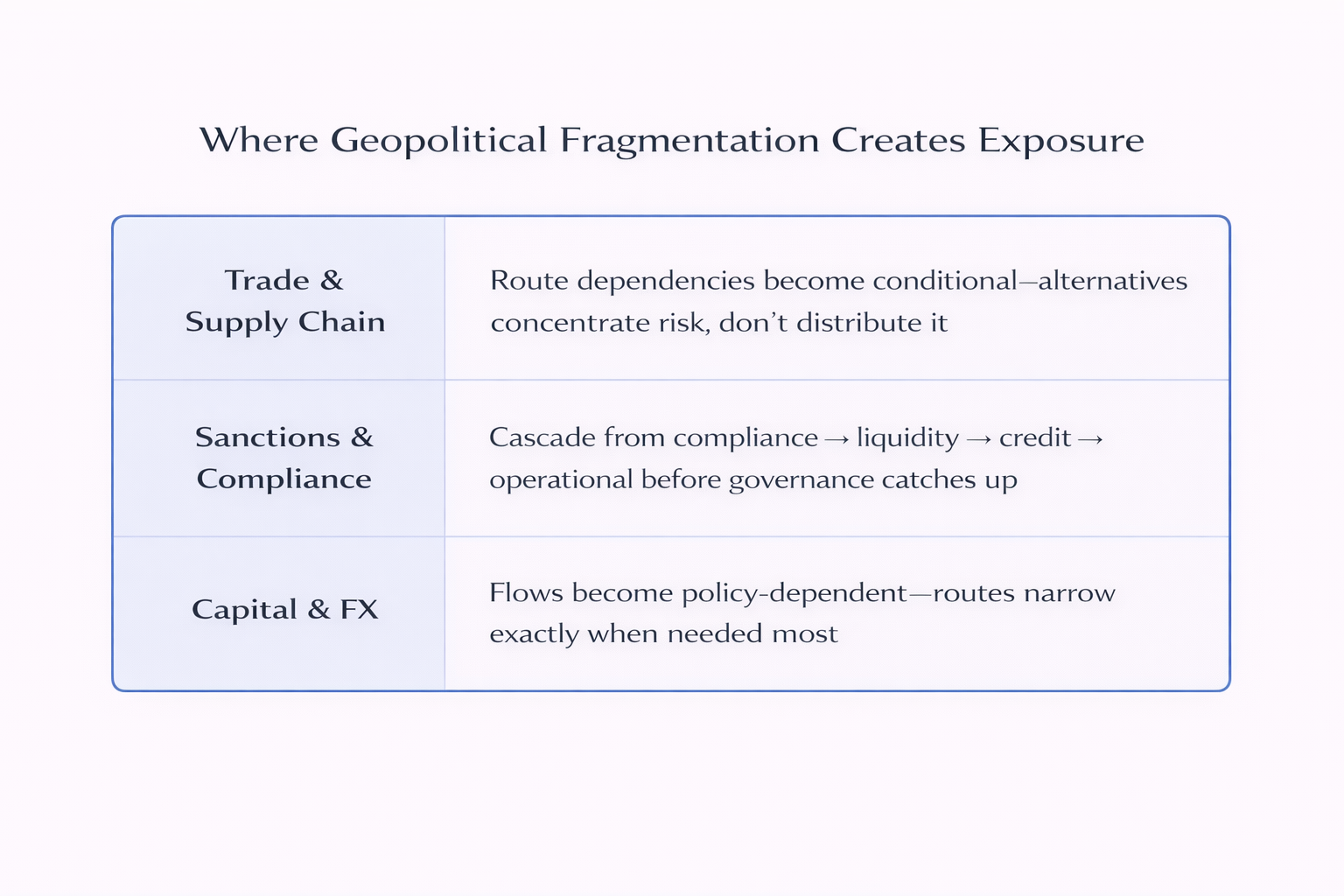
Trade route dependencies becoming conditional. I’ve watched organizations discover that shipping lanes they assumed would stay open have become politically contingent. Rerouting adds cost and time—but the real exposure is that alternative routes concentrate risk rather than distribute it. When stress hits, bottlenecks form exactly where diversification was supposed to exist.
Sanctions creating cascade effects beyond compliance. Sanctions lists change faster than credit assessments update. What starts as a compliance screening issue becomes a liquidity constraint (counterparty banks de-risk), then a credit issue (exposures can’t be unwound), then an operational problem (payment rails freeze). By the time governance catches up, the cascade has already moved through multiple domains.
Capital flows becoming policy-dependent. I’ve seen capital that looked freely movable turn conditional when geopolitical friction rises. Not because rules changed—because enforcement interpretation shifted, or because correspondent banks reassessed appetite, or because clearing infrastructure became politically sensitive. The capital exists, but the routes narrow exactly when you need them most.
The Deeper Problem: Design Lag
Most organizations can see fragmentation. Far fewer have redesigned for it.
Operating models, funding structures, governance arrangements, and data architectures still reflect an earlier world—one built on openness, enforceability, cooperation, and predictability. These assumptions don’t fail dramatically.
The risk is not that fragmentation exists.
It’s that our systems still assume it doesn’t.
📌 Key Takeaways:
- 1️⃣ Geopolitical risk has shifted from episodic disruption to structural condition—from scenario input to operating environment.
- 2️⃣ Assumption drift is the real risk: sanctions cascade from compliance to credit/liquidity/operational; jurisdictional divergence creates governance strain; capital flows become policy-dependent under stress.
- 3️⃣ Fragmentation shows up in trade route dependencies, sanctions cascades, and capital flow conditionality—often looking operational until you recognize it’s structural.
- 4️⃣ The deeper problem is design lag: organizations can see fragmentation but haven’t redesigned operating models, funding structures, or governance for persistent divergence.
- 5️⃣ Effective risk leadership means surfacing uncomfortable assumptions, translating geopolitical conditions into balance-sheet language, and framing uncertainty without false precision.
What Changes For the CRO
When uncertainty becomes structural, risk management can no longer focus primarily on prediction. The task shifts toward tolerance and adaptability.
The CROs I’ve watched navigate this well don’t have more elaborate scenarios.
They have a different orientation: they surface uncomfortable assumptions before committees force them, they translate geopolitical conditions into balance-sheet language executives can act on, and they frame uncertainty calmly—without pretending precision exists when it doesn’t.
This isn’t about forecasting outcomes. It’s about understanding how much uncertainty the institution can absorb, how quickly it can adapt, and whether leadership is making choices with eyes open or assumptions untested.
Geopolitics hasn’t become louder.
It has become more embedded.
And once fragmentation becomes structural rather than episodic, resilience stops being about buffers alone. It becomes about choices, optionality, and the ability to operate without assuming alignment that may no longer exist.
Frequently Asked Questions
For readers seeking clarity on how geopolitical fragmentation reshapes institutional risk:
How is geopolitical fragmentation different from traditional geopolitical risk?
Traditional geopolitical risk was treated as episodic—a shock you scenario-plan for, absorb, and recover from. Geopolitical fragmentation is structural—persistent divergence across regulation, trade, capital flows, and political priorities that reshapes the environment in which all risk decisions operate. You’re not preparing for an event; you’re operating inside a condition.
What are the most common assumption failures in geopolitical risk frameworks?
Three stand out: assuming sanctions remain static compliance issues when they’ve become dynamic cascades affecting credit, liquidity, and operations; assuming regulatory regimes move in lockstep when jurisdictional divergence is creating governance strain; and assuming capital flows freely when enforcement, correspondent banking appetite, and clearing infrastructure are becoming politically conditional.
How should organizations redesign stress testing for persistent fragmentation vs. episodic shocks?
Move from single baseline scenarios to multi-scenario analysis that explicitly models persistent divergence. Test transmission channels (trade routes, correspondent relationships, regulatory alignment) not just primary shocks. Include “design lag” scenarios where operating models built for an integrated world face fragmented reality. And recognize that governance speed matters—if your stress test cycle is annual but fragmentation moves quarterly, the framework is already obsolete by the time results arrive.
What does “design lag” mean in practice for risk functions?
Design lag is when your operating model, funding structure, governance arrangements, and data architecture still assume a world of openness, cooperation, and predictability—while the actual environment has fragmented. It shows up as: strategies that assume free capital movement when routes are narrowing; portfolios calibrated for geographic diversification when correlation is increasing; and governance processes that expect orderly escalation when geopolitical shifts happen faster than committees meet.
Next in series: The Quiet Withdrawal of Liquidity Providers—behavioral shifts in market-making and correspondent banking that don’t show up in standard metrics.

Posts like this are written for risk professionals who need to see patterns before metrics confirm them. Subscribe to receive new posts from The Risk Philosopher directly.
Related Reading:
- Part 1 - Why I’m Concerned About Correlation Regimes
- Explore Emerging Risks
- About The Risk Philosopher
Scenarios assume you’re preparing for a shock. Fragmentation means you’re already operating inside one—you just haven’t named it yet.