When Experience Becomes a Blindfold
Part 6 - How leadership experience and pattern recognition create confident organizational blindness—and why the more certain we are about recognizing risks, the less likely we are to notice what's actually different.

🌟 RISK JUDGMENT SERIES: When Risk Stops Behaving — Part 6 of 8
We've traced the structural foundations: silence,decision fade, governance displacement, escalation erosion, and incentive filtering. This post examines the cognitive mechanism beneath them: how experience creates confident blindness through pattern recognition.
The final posts explore how judgment gets outsourced and why urgency arrives too late—revealing how organizational failure emerges from structure, not intent.
"We've seen this before."
I've watched that phrase end more investigations than I can count.
Not because it was wrong. Often, the pattern recognition was accurate—the situation did resemble something familiar.
But resemblance isn't sameness. And treating them as identical is how experience becomes a constraint rather than a resource.
The phrase sounds like confidence. It feels like efficiency. It presents as judgment.
What it actually signals is the moment curiosity stopped.
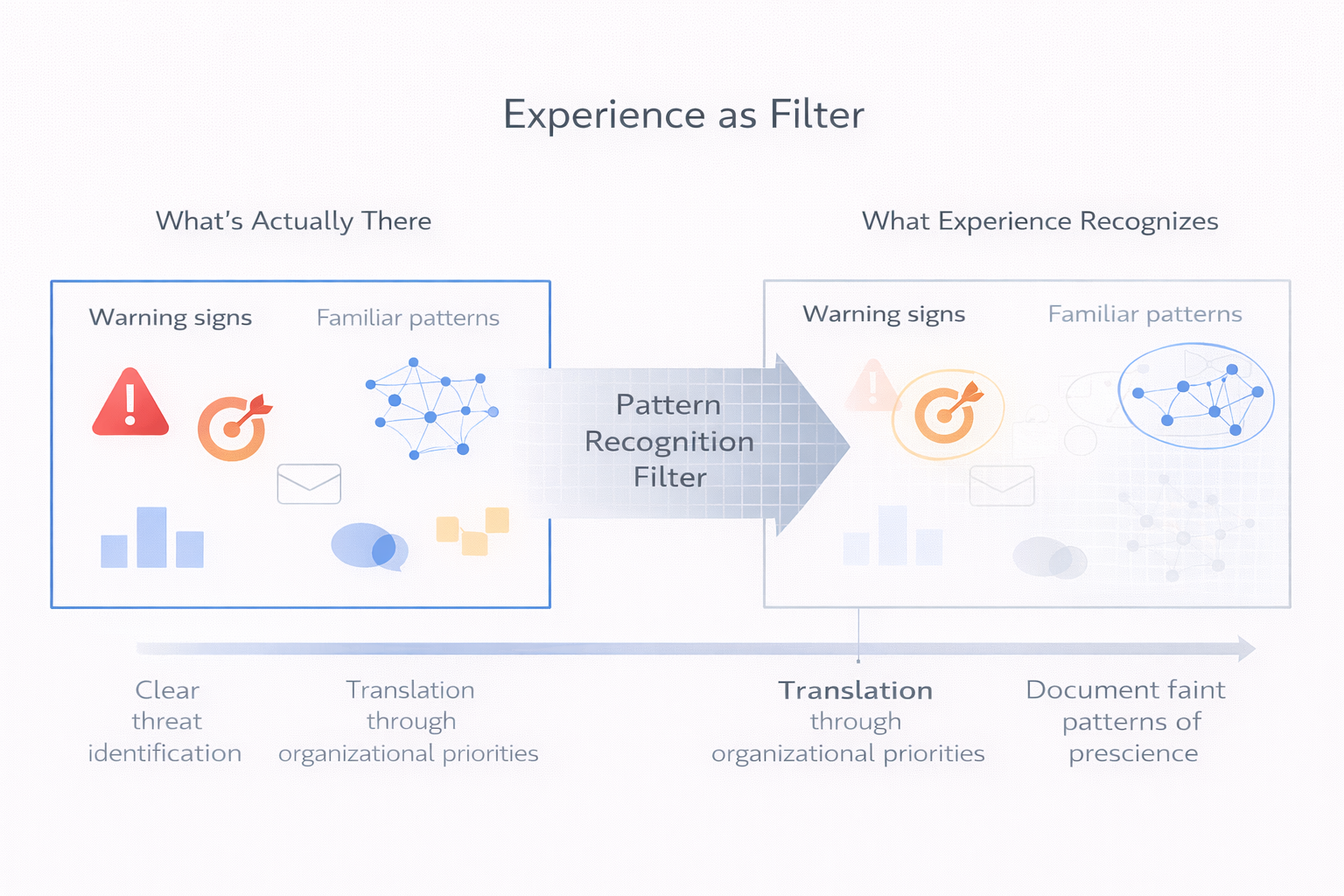
Experience is meant to sharpen perception. But pattern recognition—the mental shortcut that makes experience useful—also creates blindness. The more confidently we recognize a pattern, the less likely we are to notice what doesn't fit.
This is the quietest way judgment fails: not through ignorance, but through the certainty that comes from having seen something similar before.
Why Pattern Recognition Fails Quietly
Experience teaches us to recognize patterns. That's its value.
The executive who has navigated three market downturns develops instincts. The risk manager who has seen operational failures learns to spot warning signs. The board member who has guided companies through crises recognizes familiar dynamics.
This pattern recognition makes us faster. More efficient. Better able to act under uncertainty.
But it also makes us vulnerable.
Because patterns aren't perfect matches—they're approximations. And the mind, having found a familiar shape, stops looking for what doesn't fit.
I once watched a leadership team dismiss an emerging technology risk because "we've managed technology transitions before." The pattern was real—they had successfully navigated previous shifts. But this transition was different in ways that mattered: speed of adoption, ecosystem effects, regulatory uncertainty.
The experience wasn't wrong. The pattern recognition was accurate. What failed was the judgment that sameness in one dimension meant sameness in all dimensions.
By the time the differences became undeniable, the response window had narrowed considerably.
The organization didn't lack experience. It lacked the ability to hold experience lightly enough to notice novelty.
"Resemblance isn't sameness. And treating them as identical is how experience becomes a constraint rather than a resource."
How Confidence Narrows Vision
The more experienced someone is, the more confident they become in their pattern recognition. And confidence changes what we attend to.
When a situation feels familiar, attention narrows. We scan for confirming details—the features that match the pattern we've recognized. Disconfirming details get less weight, if they're noticed at all.
This isn't carelessness. It's efficiency. The mind is doing what it's trained to do: recognize quickly, decide confidently, move forward.
But novelty doesn't announce itself clearly. It appears as small anomalies. Details that don't quite fit. Features that should be there but aren't, or shouldn't be there but are.
These signals get filtered out—not because they're invisible, but because they don't fit the pattern that experience has already identified.
The result: the more confident we are that we've seen something before, the less likely we are to notice we haven't.
"This is why experience can become a blindfold rather than a lens. Not because it makes us see incorrectly, but because it makes us stop looking."
This is why experience can become a blindfold rather than a lens. Not because it makes us see incorrectly, but because it makes us stop looking.
When The Map Becomes the Territory
There's a deeper problem.
Over time, experienced leaders don't just recognize patterns—they build mental models. Frameworks for understanding how organizations work, how markets behave, how risks emerge and resolve.
These models are useful. They compress complexity into something manageable. They allow rapid assessment under uncertainty.
But models simplify. That's their function.
This is the cognitive version of what we've already seen structurally: how incentives filter truth through reward structures, how governance displaces judgment through process, how escalation erodes through accumulated delay.
Experience filters reality through familiar patterns—not deliberately, but automatically.
Alfred Korzybski's warning becomes relevant: "The map is not the territory."
When leaders have seen enough, the model can begin to substitute for reality. What doesn't fit the model gets dismissed as noise, outlier, or poorly framed. The model itself—built from years of pattern recognition—becomes unquestionable.
This is experience at its most dangerous: not as ignorance, but as confident certainty that prevents investigation.
The Cost of Confident Misrecognition
What makes this particularly difficult is that experience-based misjudgment doesn't feel like error.
It feels like pattern recognition working exactly as it should.
The warning signs were present. They were visible. Sometimes they were even discussed.
But they were interpreted through a lens shaped by previous experience—and that lens filtered them into familiar categories that didn't capture what was actually happening.
By the time the differences became clear, they were no longer early warnings—they were crisis indicators.
The cost wasn't ignorance. It was confident misrecognition.
The organization had the right experience. It just applied it to the wrong situation—and confidence prevented the correction until it was too late.
Why Experience-Based Blindness Persists
The difficulty is that experience-based blindness doesn't feel like blindness.
It feels like clarity. Like efficiency. Like the confidence that comes from having been here before.
There's no moment when someone thinks "I'm ignoring important signals because I'm pattern-matching incorrectly." The pattern recognition happens automatically, beneath conscious awareness.
By the time the misrecognition becomes visible, the question isn't "Why didn't we see this differently?" but "Why didn't anyone challenge our interpretation earlier?"
And the answer is usually: someone did. But their challenge was filtered through the same experienced confidence it was trying to correct.
This is why experience can be the most difficult constraint to overcome: it doesn't present as a limitation. It presents as expertise.
When pattern recognition operates automatically, and confidence prevents questioning, even capable people struggle to see what their experience has taught them to filter out.
This is why judgment gets outsourced and why urgency arrives too late—when experience creates confident blindness, even clear signals get filtered through familiar patterns until it's too late to respond effectively.
📌 Key Takeaways:
- 1️⃣ Experience teaches pattern recognition—which makes us faster but also creates blindness to what doesn't fit
- 2️⃣ The more confidently we recognize a pattern, the less likely we are to notice novelty or disconfirming details
- 3️⃣ Resemblance isn't sameness—experience-driven confidence can misapply accurate patterns to different situations
- 4️⃣ Confidence narrows attention to confirming details while filtering out anomalies that don't fit the recognized pattern
- 5️⃣ Experience-based blindness doesn't feel like limitation—it presents as expertise, making it the hardest constraint to correct
Experience is not the problem.
Certainty is.
Pattern recognition is meant to sharpen judgment—but when it creates certainty, it prevents the questioning that would reveal what we're missing.
Frequently Asked Questions
For readers seeking quick answers about how experience can become a constraint:
How does experience become a constraint rather than a resource?
Experience teaches pattern recognition, which is valuable—it makes us faster and more efficient under uncertainty. But the mind, having found a familiar pattern, stops looking for what doesn't fit. Small anomalies, disconfirming details, and features that should be present but aren't get filtered out—not because they're invisible, but because they don't match the pattern already identified. The more confident we are in our pattern recognition, the less likely we are to notice we're wrong.
Why don't experienced people notice when they're misapplying patterns?
Because pattern recognition happens automatically, beneath conscious awareness. It doesn't feel like limitation—it feels like clarity and expertise. When a situation seems familiar, attention narrows to confirming details while disconfirming signals get less weight. By the time the misrecognition becomes visible, it's usually framed as "Why didn't anyone challenge this earlier?" rather than "Why was I so confident?" The experience itself prevents the questioning that would reveal the misapplication.
What's the difference between valuable experience and experience-based blindness?
Valuable experience recognizes patterns while remaining open to novelty—it holds conclusions lightly and attends to disconfirming details. Experience-based blindness occurs when pattern recognition creates certainty, narrowing attention and filtering out signals that don't fit. The key difference is confidence: experienced judgment maintains doubt even while recognizing patterns; experienced blindness treats resemblance as sameness and stops looking for what doesn't fit.
Next in the series: How Judgment Gets Quietly Outsourced
We've examined how silence, decision fade, governance displacement, escalation erosion, incentive filtering, and experience-based blindness compound. The next post explores the final mechanism: when organizations outsource judgment to tools, frameworks, and process—not from lack of capability, but because the environment makes exercising judgment increasingly difficult.

Subscribe to The Risk Philosopher to follow this 8-part series examining how organizational failure emerges from structure, not intent—and receive new posts on risk judgment and emerging risks.
Related Reading:
In This Series:
- Part 4: Risk Escalation Fails Long Before Anyone Raises Their Voice
- Part 5: How Incentives Quietly Shape What Gets Taken Seriously
- Part 7: How Judgment Gets Quietly Outsourced (Coming soon)
The blindfold isn't ignorance—it's the confidence that we've already seen what we're looking at.