Good Decisions Don’t Always Survive Organisations
Part 2 - How sound decisions fade after the meeting—not through rejection but through gradual loss of ownership.

🌟 RISK JUDGMENT SERIES: When Risk Stops Behaving — Part 2 of 8
In Part 1, we examined why capable people stay silent about visible risks. This post explores what happens next: how sound decisions fade even after they're made—not through rejection, but through a quieter loss of ownership and sponsorship.
The posts that follow examine how governance displaces judgment, how escalation erodes, and why urgency arrives too late. Together, they reveal how organizational failure emerges from structure, not intent.
I've watched sound decisions vanish inside organizations—not because anyone disagreed with them, but because no one kept carrying them forward.
The meeting ends. Everyone nods. The decision is documented.
Three months later, nothing has moved.
Not because the judgment was wrong. Not because someone actively opposed it. But because once attention shifted elsewhere, the decision lost sponsorship—and without sponsorship, even the clearest judgment slowly dissolves into "something we discussed once."
Most good decisions are not rejected.
They are acknowledged. Supported in principle. Sometimes even praised for their clarity.
And then they quietly disappear.
Few organizations have a reliable mechanism for decision custody—for holding judgment in place once attention moves elsewhere.
This is one of the least examined failures in organizational life—not the inability to exercise judgment, but the inability to preserve it once it leaves the room.
This is a failure of governance, not intellect—a breakdown in how organizations retain, sponsor, and carry decisions over time.
Agreement Is Not the Same as Survival
From the outside, it's easy to assume that decisions fail because someone opposed them.
From the inside, the pattern is subtler.
The judgment may have been sound. The discussion balanced. The conclusion shared.
But once attention shifts—once boards and executives are pulled toward louder, more immediate concerns—the decision loses sponsorship.
"Consensus remains. Ownership does not."
What follows is not active rejection, but gradual neglect. The decision stops being carried forward, not because it was wrong, but because nothing in the system requires anyone to keep carrying it.
This is the organizational echo of individual silence—both emerge from systems that diffuse accountability.
How Decisions Fade Without Anyone Saying No
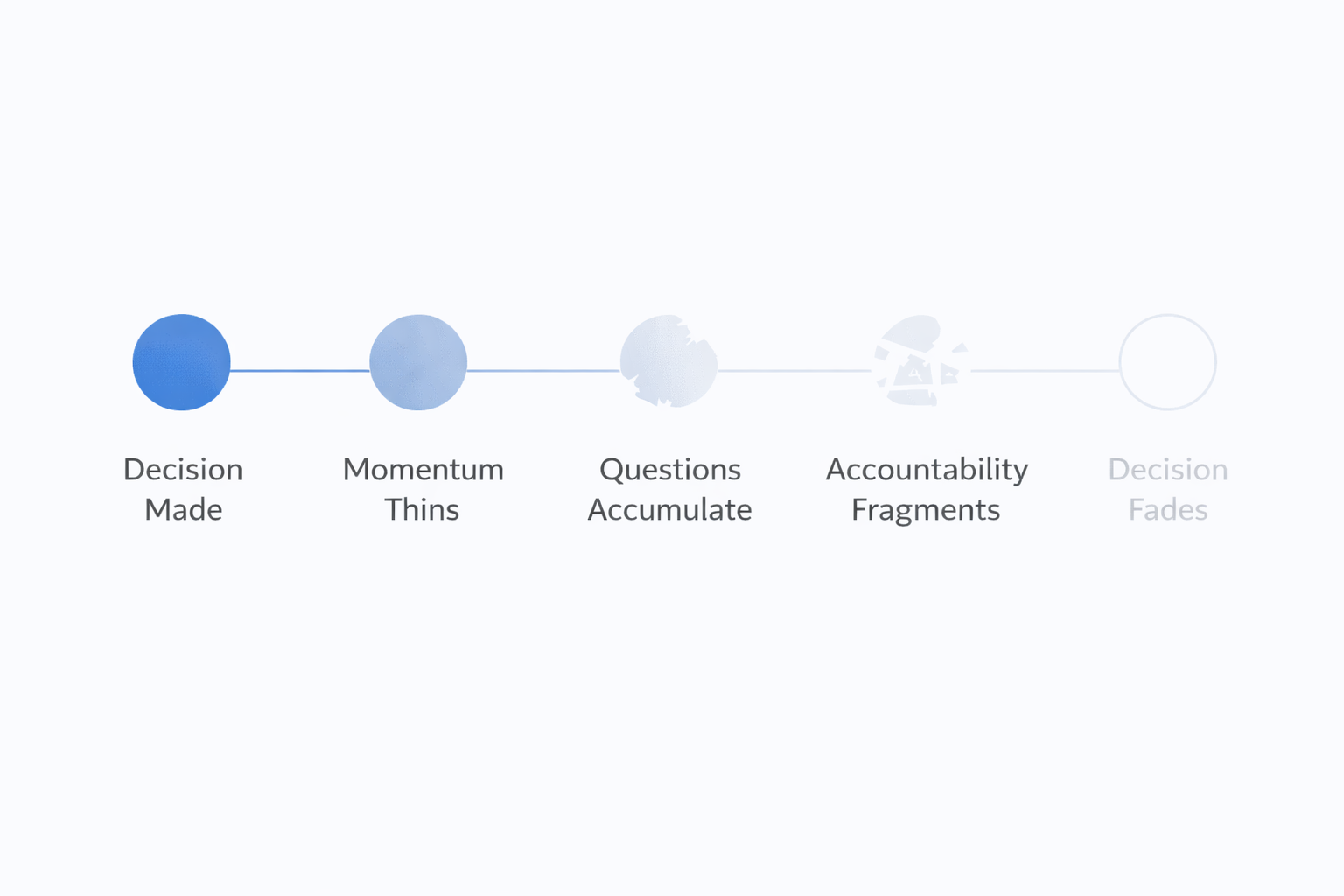
Organizations rarely kill good decisions outright. They let them dissolve across the value chain.
Momentum thins. Dependencies surface. Questions accumulate. Accountability fragments.
Requests for further analysis appear—often framed as diligence rather than delay.
Additional data is sought, not because it is expected to change the conclusion, but because postponement feels safer than commitment.
Alignment is preserved. Responsibility is deferred.
What looks like prudence is often hesitation rendered respectable.
This gradual erosion is how risk escalation begins to fail—through accumulated delay that each feels like prudence.
When Caution Feels Like Competence
Here is the more uncomfortable truth.
When a good decision fades, it is rarely experienced internally as a loss.
It is reframed—as premature, as too risky, as misaligned with strategic priorities. These explanations allow the organization to maintain a sense of rationality and control. Leaders believe they are being careful, not relinquishing something valuable.
This is reinforced by familiar mental models. Known risks feel tangible. Novel ones feel speculative. What does not fit existing categories is easier to set aside than to absorb.
I once watched a pricing decision—carefully studied, unanimously agreed—sit in "further review" for nine months. Not because anyone thought it was wrong. But because moving forward meant accepting accountability for a specific outcome, while delay felt like continued thoughtfulness.
By the time leadership asked why nothing had changed, the original market conditions had shifted. The decision hadn't failed. It had simply expired while everyone was being careful.
So the disappearance of the decision barely registers. Nothing visibly breaks. No failure is declared. The system moves on, convinced it has avoided error rather than opportunity.
Delay as a False Form of Safety
Delay often feels benign because it appears reversible.
If nothing is decided, nothing seems to be lost.
In reality, postponement quietly commits the organization to its existing path. Markets evolve. Competitors act. Constraints harden. What once felt optional becomes unavailable.
Yet because the decision was never formally rejected, there is no moment of reckoning—only a gradual narrowing of possibility.
The organization experiences this as external pressure—"the market moved," "competitors acted first," "the window closed."
But the constraint was internal. The decision to wait was itself a decision—just one that no one owned.
What Actually Survives
Survival, in organizations, is not a neutral outcome—it is shaped by what the system is designed to tolerate.
Over time, organizations become adept at selecting decisions that can survive their internal structures.
Not necessarily the most accurate ones.
Not the most forward-looking ones.
The ones that align with existing incentives. The ones that do not unsettle identity or established measures of success. The ones that pass cleanly through committees without requiring anyone to step forward and own the consequences.
A good decision that threatens these structures is less likely to endure than a weaker one that fits neatly inside them.
This is why governance can become a substitute for judgment—the system selects for decisions that survive its structures, not necessarily decisions that address reality.
Recognition Arrives Late — and Sideways
Awareness tends to arrive from outside the organization.
A competitor succeeds with a similar idea.
An incident exposes a vulnerability that had been discussed.
A market shift makes an earlier proposal look quietly prescient.
Only then does the organization reconstruct the story and say, "We should have listened."
But this recognition is retrospective. In real time, the system believed it was being sensible, measured, and responsible. It did not know it had lost anything at all.
Most organizations do not fail because they lack judgment.
They fail because they cannot always recognise when a good decision has quietly slipped out of reach—and by the time the loss becomes visible, recovery is no longer straightforward.
When decisions lose custody, even sound judgment cannot endure.
📌 Key Takeaways
- 1️⃣ Agreement is not the same as survival—decisions need ongoing sponsorship, not just initial consensus
- 2️⃣ Decisions fade through accumulated delay that each feels reasonable in isolation
- 3️⃣ Postponement feels reversible but quietly commits organizations to their existing path
- 4️⃣ Organizations select for decisions that survive their structures, not necessarily decisions that address reality
- 5️⃣ Decision custody—the ability to hold judgment in place once attention moves—is rarely designed into organizational systems
Frequently Asked Questions
For readers seeking quick answers to specific questions about why good decisions fade:
What is decision custody and why does it matter?
Decision custody is the organizational capacity to hold judgment in place once attention moves elsewhere. Without it, even sound decisions fade—not through rejection, but through loss of sponsorship. Someone must actively carry the decision forward between meetings, protect it from drift, and maintain momentum. When custody is unclear, decisions dissolve into "something we discussed once" while everyone assumes someone else is handling it.
How do good decisions fade without anyone actively opposing them?
Decisions fade through accumulated delay that each feels reasonable: dependencies surface, questions accumulate, additional analysis is requested. Ownership shifts from individuals to committees, from action to oversight. Each delay is justified independently—"let's monitor," "we'll revisit next quarter"—but together they condition the organization to experience persistence as stability. By the time urgency returns, market conditions have changed and the original window has closed.
Why don't organizations recognize when decisions are fading?
Because decisions were never formally rejected, there's no moment of reckoning—only gradual narrowing of possibility that feels like external constraint rather than internal choice. Organizations experience this as "the market moved" or "competitors acted first," when the real constraint was internal: the decision to wait was itself a decision, just one that no one owned. Recognition arrives only in hindsight, after options have collapsed and recovery is no longer straightforward.
Next in the series: When Governance Becomes a Substitute for Judgment
We've now seen how silence becomes rational and how decisions lose custody. The next post examines what happens when governance itself changes—from supporting judgment to replacing it. When process absorbs anxiety, organizations feel safer but decide less clearly.
Subscribe to The Risk Philosopher to follow this 8-part series examining how organizational failure emerges from structure, not intent—and receive new posts on risk judgment and emerging risks.
Related Reading:
In This Series:
- Part 1: When Silence Is the Rational Choice
- Part 3: When Governance Becomes a Substitute for Judgment (Coming soon)
- Part 4: Risk Escalation Fails Before Anyone Raises Their Voice (Coming soon)
Decisions don't fail when they're rejected—they fail when no one remembers to keep carrying them.