The World Still Runs Through Chokepoints
Part 1 - Globalisation optimised for efficiency, not resilience. The geometry it produced was extremely narrow in critical places—energy routes, shipping corridors, insurance markets. Complexity became a proxy for resilience. The more elaborate the system, the harder to see where it ran thin.
📊 EMERGING RISKS SERIES: The Chokepoint Fallacy — Post 1 of 4
This is Post 1 of "The Chokepoint Fallacy" — a series on how global systems quietly concentrated risk while organisations assumed the opposite.
Globalisation was sold as distributed resilience. This series examines what it actually built: a small number of structural chokepoints that most risk frameworks were never designed to see.
There’s a particular kind of confidence that comes from complexity.
When supply chains span dozens of countries, when energy flows through layers of intermediaries, when financial systems connect thousands of counterparties — complexity starts to feel like protection. That something this elaborate, this globally distributed, couldn’t possibly fail in a single place.
That assumption has had a difficult few months.
What we’re watching isn’t a geopolitical shock disrupting a resilient system.
It’s a resilient-looking system revealing that it was never as distributed as it appeared. The routes, the capacity, the pricing mechanisms, the insurance structures — these didn’t break under unusual stress. They buckled under conditions the system was always vulnerable to.
The problem wasn’t the shock. The problem was the story we told ourselves about what the system could absorb.
How Concentration Happened
The concentration didn’t arrive through negligence. It arrived through optimisation.
Over three decades, global trade settled into its most efficient geometry. Energy infrastructure oriented around the lowest-cost extraction and the shortest viable route to market. Shipping networks consolidated around a small number of high-throughput corridors because volume density made those routes cheaper, faster, and better serviced than alternatives. Insurance capacity deepened in a handful of specialist markets because expertise and capital tend to pool where risk is most legible and most frequently priced.
Each decision made sense individually. By conventional measures, each was rational. The problem is that rational local optimisation often produces irrational system geometry — and the geometry that emerged was, in several critical places, extremely narrow.
Consider what that narrowness looks like in practice. A significant share of global liquefied natural gas moves through a small number of maritime corridors. Fertiliser supply chains — and therefore food production capacity for billions of people — run through a limited set of export origins and processing nodes. Marine insurance for large portions of global trade is written by a market with genuine depth in perhaps four or five locations. Shipping capacity, when disrupted, cannot be rerouted freely — the vessels, the port infrastructure, the crewing arrangements, the flag state certifications — these don’t flex quickly.
This is not a diversified system with redundancy.
It is a system that looks diverse at the surface and runs thin underneath.
The concentration was, in every case, the logical outcome of the incentive structure. Which is precisely why it was so difficult to see.
"Globalisation didn’t distribute risk. It disguised it."
Why Organisations Missed It
Risk frameworks are not neutral instruments. They encode a worldview.
The worldview embedded in most enterprise risk frameworks — built and refined across the 1990s and 2000s — assumed several things about the operating environment that have since quietly expired. It assumed that major trade routes would remain functionally open. It assumed that specialist insurance markets would remain willing to price and bear risk on normal terms. It assumed that geopolitical actors, whatever their differences, shared a basic interest in maintaining the conditions for global commerce.
These weren’t naïve assumptions at the time. They were reasonable extrapolations from a long period of relative stability. The mistake wasn’t making them. The mistake was not revisiting them.
What this produced, in practice, was a generation of risk assessments that modelled volatility within a stable system rather than questioning the stability of the system itself. Scenario planning asked: what happens if this route is disrupted temporarily? It rarely asked: what happens if the assumption that this route is available at all turns out to be wrong?
I’ve watched risk teams run sophisticated stress tests — detailed, well-resourced, technically credible — that nonetheless couldn’t surface the vulnerability because the concentration wasn’t inside the model. It was in the model’s foundations. The question being asked was the wrong one. And frameworks are very good at answering the question they were built to ask.
This is the structural failure underneath the current disruption. Not that organisations lacked information. Not that signals were absent. But that the architecture of their risk thinking was optimised for a world that no longer exists — and that the gap between the assumed world and the actual world had been growing, quietly, for years before anything broke.
What a Chokepoint Actually Is
The result was a system that looked stable on paper and fragile in reality. To see why, it helps to be precise about the structure of a chokepoint.
The word is used loosely. It’s worth defining it properly.
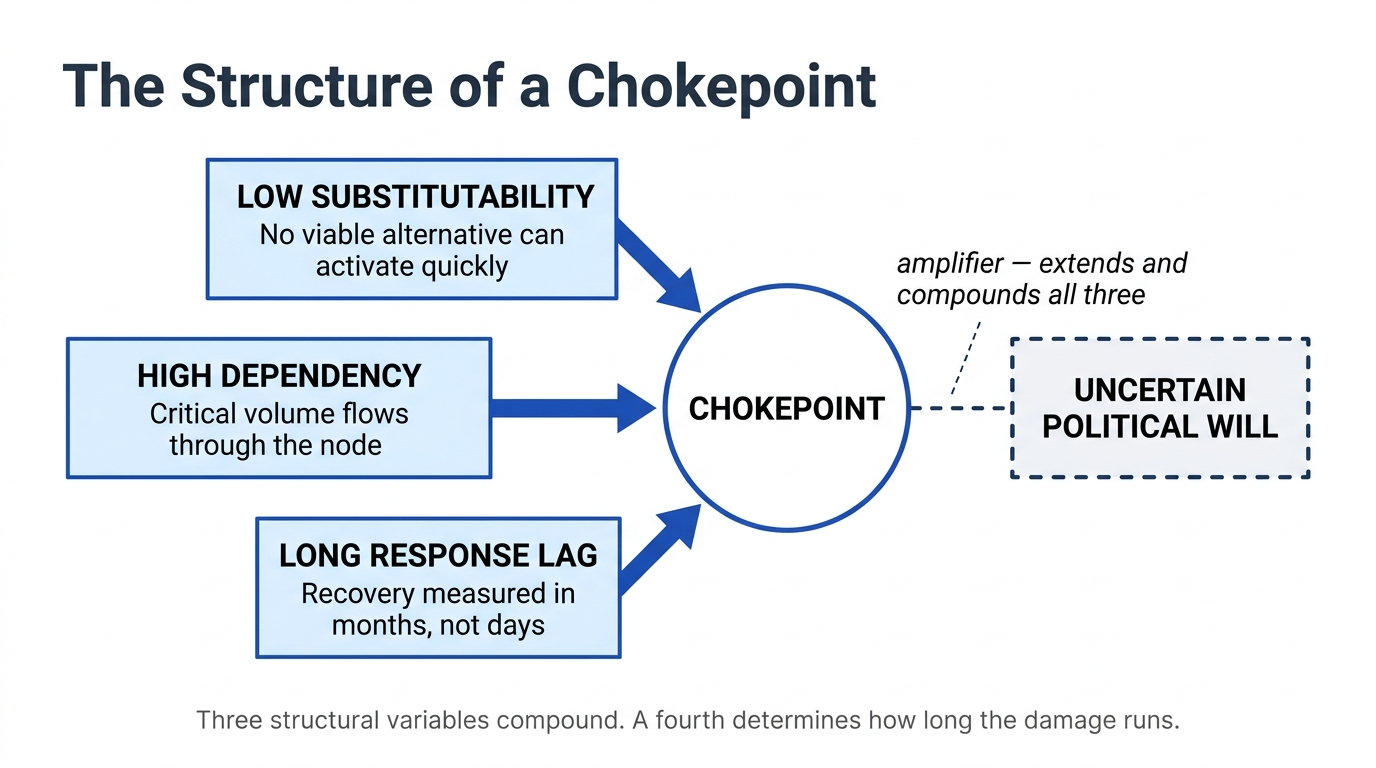
A chokepoint, as I’m using it in this series, is a node in a critical system where three conditions converge: high dependency, low substitutability, and long response lag. These variables compound. High dependency means that a large volume of something essential flows through the node. Low substitutability means there is no viable alternative routing, sourcing, or capacity that can be activated quickly. Long response lag means that even if substitutes exist in theory, the time required to deploy them is measured in months or years, not days or weeks.
What makes a chokepoint dangerous — rather than merely constrained — is when a fourth condition is present: uncertain political will. When the entities capable of resolving a chokepoint disruption have interests that may not align with rapid resolution, the response lag extends further and the damage compounds in ways that most scenario models don’t price.
Hormuz is the canonical example. But Hormuz is canonical precisely because it has been visible for decades. The more dangerous chokepoints are the ones that haven’t yet been named in a board risk register — the systems where dependency is high, alternatives are thin, and the assumption of availability has never been seriously tested.
📌 Key Takeaways:
1️⃣ Globalisation optimised for efficiency, not resilience — and the geometry it produced was, in several critical places, extremely narrow.
2️⃣ Risk frameworks built in the 1990s and 2000s encoded assumptions about trade stability, insurance availability, and geopolitical incentives that have since quietly expired.
3️⃣ The failure wasn't missing the stress-test. It was running sophisticated models on top of foundations that were never stress-tested at all.
4️⃣ A chokepoint is a node where high dependency, low substitutability, and long response lag converge. When uncertain political will is added, the damage compounds in ways most scenario models don't price.
5️⃣ The more dangerous chokepoints are not the ones that made the news. They are the ones that haven't been named in a board risk register yet.
Globalisation didn’t distribute risk. It disguised it. It took physical concentration — narrow straits, single-origin supply lines, thinly capitalised insurance markets — and wrapped it in the language of diversification. Complexity became a proxy for resilience. The more elaborate the system looked, the harder it became to see where it actually ran thin.
This series examines what’s running thin. Not the headlines — those will keep moving. But the structural conditions underneath them: the places where critical systems depend on assumptions that quietly expired, and where most organisations’ frameworks were never designed to look.
The first thing worth understanding is how the concentration happened. Not suddenly, and not by accident.
Frequently Asked Questions
For readers seeking quick answers about chokepoint risk and supply chain concentration:
What is a chokepoint in global risk management?
A chokepoint is a node in a critical system where three conditions converge: high dependency, low substitutability, and long response lag. These variables compound. When a fourth condition — uncertain political will — is present, the response lag extends further and damage compounds in ways most scenario models don't price.
Why did globalisation concentrate rather than distribute risk?
Globalisation optimised for efficiency rather than resilience. Trade settled into its most efficient geometry — energy infrastructure around lowest-cost routes, shipping around high-throughput corridors, insurance capacity around specialist markets. Each decision was locally rational. The problem is that rational local optimisation often produces irrational system geometry, creating critical dependencies through a small number of narrow nodes.
Why did enterprise risk frameworks fail to identify supply chain concentration risk?
Enterprise risk frameworks built in the 1990s and 2000s encoded assumptions that have since expired: that major trade routes would remain open, that insurance markets would price risk on normal terms, and that geopolitical actors shared a basic interest in maintaining global commerce. These frameworks modelled volatility within a stable system rather than questioning the stability of the system itself. The concentration wasn't inside the model — it was in the model's foundations.
What is chokepoint concentration risk?
Chokepoint concentration risk is the systemic vulnerability that emerges when critical flows — energy, logistics, food supply, financial settlement — depend on a small number of nodes with limited substitutes and long recovery times. The risk is structural rather than event-driven: the chokepoint exists before any disruption occurs. The disruption simply makes it visible.
How should organisations stress-test for chokepoint risk?
The first step is mapping where critical dependencies actually run — not the diversified picture in the procurement register, but the physical and institutional nodes those supply chains actually flow through. The question to ask is not "what happens if this route is disrupted temporarily?" but "what is our exposure if the assumption that this route is available at all turns out to be wrong?" Subsequent posts in this series develop a practitioner framework for exactly this stress-test.
Next in The Chokepoint Fallacy
The Assumptions Hidden Inside Risk Frameworks
The vulnerabilities didn't stay hidden because organisations weren't looking. They stayed hidden because the frameworks doing the looking weren't built to find them. Publishing June 9.
The Risk Philosopher
Risk analysis for practitioners who think structurally.
Biweekly emerging risk analysis and weekly organisational diagnostics — written by a practitioner, for practitioners. No frameworks recycled from textbooks. No commentary dressed up as insight.
Subscribe free →“The opposite of a resilient system isn’t a fragile one. It’s one that performs resilience until the moment it can’t.”